Gainsight review verdict: Gainsight Customer Success is a serious option for teams that need account health, coordinated post-sale work and configurable customer journeys in one operating environment. Its strongest use case isn't collecting another dashboard. It's turning a warning, a customer goal or a renewal risk into an owned action that someone can verify.
The trade-off is operational. Gainsight offers depth, but buyers shouldn't assume that buying a capable platform automatically creates clean customer data, useful playbooks or accountable handoffs. Those outcomes require a deliberate design and someone to maintain it. For a lean team without a CS operations owner, that burden can outweigh the benefits. You won't fix an unclear process by giving it more configuration options.
- Best fit: a CS organization with complex account data, repeatable lifecycle motions and ownership for administration.
- Strength: customer context can lead to Calls to Action, playbooks, success plans and coordinated outreach.
- Watch-out: configuration and ongoing data governance can consume the time the automation was meant to save.
- Pricing: Gainsight lists Essentials and Enterprise but asks buyers to request pricing.
- Buying test: trace a real customer commitment from promise to owner, due date and verified outcome.
What is Gainsight Customer Success, and who is it for?
Gainsight Customer Success is a configurable post-sale operations platform. It brings customer context, health signals, CSM activity and planned interventions into connected workflows. It's most compelling when a company has multiple data sources and needs CS managers, CS operations and revenue leaders to act on the same customer picture.
Gainsight's Customer 360 is designed as an account information hub, while Cockpit is the working area for customer activities and Calls to Action. Journey Orchestrator, Success Plans and renewal workflows extend that foundation into scaled engagement and revenue coordination. This is a wider operating scope than a simple task tracker or customer notes repository.
A useful fit test is whether your organization has recurring cross-functional customer work. If a risk signal must become a CSM task, a customer meeting, a remediation owner and a recorded result, a configurable CS platform has a clear job. If your team mostly needs a short shared list of promises and owners, start with that workflow before committing to a larger system. You don't need enterprise automation to learn who owns the next action.
Gainsight's strongest capabilities in day-to-day CS work
Gainsight's main strengths are account context, structured interventions, success planning and automation. The capabilities matter most when they form a connected workflow rather than isolated screens. The sections below separate what the product supports from the operational discipline a buyer still needs to supply. It isn't the same thing as purchasing an outcome.
Customer 360 and health: a useful view needs trustworthy inputs
Gainsight's Customer 360 consolidates business information from different sources so CSMs can prepare for conversations and spot context that might otherwise be scattered. Health Scorecards and Adoption Explorer add structure to account status and usage signals. A health score is useful for prioritization, but it isn't proof that a customer received the outcome they were promised.
In practice, define the meaning of each signal before making it part of a renewal workflow. A drop in usage might reflect an adoption problem, a seasonal pattern or a customer migration. A strong implementation gives CSMs a way to inspect the underlying evidence, identify the accountable owner and record the action taken. Otherwise a colorful score can make weak assumptions look precise. That doesn't tell the CSM which customer promise remains open.
Cockpit and playbooks: from a warning to an accountable action
Cockpit is where a CSM can work through Gainsight Calls to Action and related tasks. Admins can customize CTA types and the Cockpit view, which is valuable when teams have different response motions for onboarding delays, executive escalations and renewal risks.
A playbook should specify the trigger, responsible person, expected action, due date and evidence of completion. A generic task labeled 'follow up' isn't enough. A better CTA might say that an implementation owner must confirm a blocked integration, document the customer-facing workaround and obtain the customer's acceptance. Gainsight can organize the work, but the team still has to define what 'done' means. An alert won't solve a problem that nobody owns.
Success Plans and Customer Goals: make promises visible
Gainsight supports Success Plans and Customer Goals for tracking agreed outcomes and the activities connected to them. That can give Sales and CS a common reference after the deal closes, especially when the customer's desired business result is more specific than a product adoption target.
A plan becomes more useful when it separates a customer goal from the vendor's deliverable. 'Improve onboarding' is a goal. 'Provide the approved migration checklist by Friday' is a commitment. Capture the source of the promise, its owner, the customer's confirmation and the acceptance criteria. Then use Gainsight tasks and plans to manage the work without pretending the existence of a plan proves the commitment was fulfilled. You can't close a promise just because a task looks green.
Timeline and Journey Orchestrator: evidence and scale
Gainsight's Timeline records customer interactions, while Journey Orchestrator supports automated engagement programs. Together they can connect a human account conversation with a structured follow-up motion. That's useful for recurring onboarding updates and segment-based communications, provided the message rules are grounded in current account data.
Automated messages don't remove accountability. Teams should define suppression rules, who approves sensitive outreach and how a customer reply returns to an owner. If an account has an unresolved contractual promise, an automated celebration email can undermine trust. A good operating design makes those exceptions visible before an outreach program runs. Otherwise the CSM doesn't know which message was sent or why.
Renewal Center and forecasting: distinguish risk from obligation
Gainsight's Renewal Center is intended to support renewal forecasting and account risk decisions. The official package documentation shows Renewal Center as included with Enterprise and available as an add-on to Essentials. That distinction matters when comparing quotes and building a rollout plan.
Renewal likelihood and health scores help prioritize attention, but they shouldn't replace a record of actual commitments. A renewal owner needs to know which remediation steps were promised, which are late, who accepted a workaround and what the customer considers complete. Those are different questions from whether the account appears healthy in a model. They aren't interchangeable measures of success.
What do Gainsight users actually like and dislike?
Buyers usually weigh Gainsight's flexibility and workflow automation against the setup and administration effort it takes. That tradeoff is an editorial reading, not a result from our own product testing. Review platforms reflect different respondent mixes and shouldn't be treated as a controlled comparison.
On G2, Gainsight Customer Success displays a 4.5 rating from 1,764 reviews, checked October 2026. The vendor description on that G2 listing centers on multidimensional health scoring, renewal and expansion workflows and AI-generated account summaries. The rating is a snapshot, not a promise about your implementation. It won't tell you whether your account hierarchy can be mapped cleanly.
Individual G2 reviews describe both useful customer visibility and real administrative friction. One administrator praised the flexibility of data configuration, while another user described the work needed to tune reporting and account relationships. Those experiences aren't a substitute for a hands-on evaluation with your own data.
The most useful interpretation isn't simply 'powerful but complex.' Buyers should test where the complexity lives. If an admin must maintain data mappings, alert rules, lifecycle definitions and access permissions, budget for that work. If CSMs need extensive training to understand why an alert fired, simplify the motion before scaling it. A flexible system can be a strong asset, yet that flexibility won't compensate for unclear ownership.
Gainsight pricing and what a buyer should verify
Gainsight's public Customer Success pricing page names Essentials and Enterprise and uses Request Pricing rather than displaying a public USD subscription amount. Don't substitute a third-party per-seat estimate for a vendor quote. A buyer needs to verify the actual license scope, customer record allowance, optional modules and implementation work.
The official package overview distinguishes the included full-user allowances: Essentials includes 10 full users, while Enterprise includes 20. It also describes package-level differences for advanced features. These are documented package descriptions, not a quote for your organization, and the final order form controls what you buy.
| Gainsight buying question | What to check in the quote |
|---|---|
| Gainsight CS edition | Essentials or Enterprise and the exact package description |
| Gainsight CS access | Full users, viewers and permission requirements |
| Gainsight CS account scope | Customer records, account hierarchy and data limits |
| Gainsight CS workflow scope | Whether Renewal Center and other advanced modules are included |
| Gainsight CS rollout | Data mapping, implementation services, admin training and support |
A sound procurement review doesn't stop at the subscription line. Ask who will own the system after implementation, who changes the health model, how broken integrations are detected and how exceptions reach the right person. Put those answers into the statement of work or operating plan. You can't rely on a sales demo as an implementation specification. An attractive license number isn't helpful if the team can't run the workflows it bought.
A real-world Gainsight workflow: from sales promise to verified outcome
The clearest way to evaluate Gainsight is to trace a customer commitment through the entire post-sale process. The workflow below is a proposed operating test, not a claim that Gainsight automatically captures every sales promise or certifies delivery. It shows what your team should configure and demonstrate.
Capture the original promise
Record the exact customer-facing commitment, its source and the acceptance criterion during the Sales to CS handoff.
Assign an accountable owner
Put the responsible team and due date on the work. Distinguish the person coordinating it from the person delivering it.
Connect the account context
Use the account view and relevant health signals to make the work visible without treating a score as completion evidence.
Run the intervention
Use a CTA, playbook or Success Plan to coordinate the agreed tasks and any customer communication.
Verify the outcome
Capture the customer's confirmation or the agreed evidence. Close the commitment only when the acceptance criterion is met.
Consider a customer who was promised a migration checklist before launch. Sales recorded the request, but the implementation team hasn't acknowledged it. A well-designed handoff makes the promise visible to CS, assigns an implementation owner and triggers an escalation if the checklist isn't delivered. The CSM can then document the customer's approval rather than marking the work complete merely because an internal task was checked off. If that approval isn't recorded, the team still has an evidence gap.
The distinction is non-negotiable: activity is not the same as delivery. A system can record a meeting, task or health improvement while a contractual or operational promise remains open. This is where CS operations teams can create information gain beyond standard feature checklists.
A Gainsight buying checklist for CS operations leaders
A Gainsight evaluation should include a workflow demonstration, a data and ownership review and a realistic administration plan. The checklist is designed to expose hidden dependencies before a sales proposal becomes an implementation project.
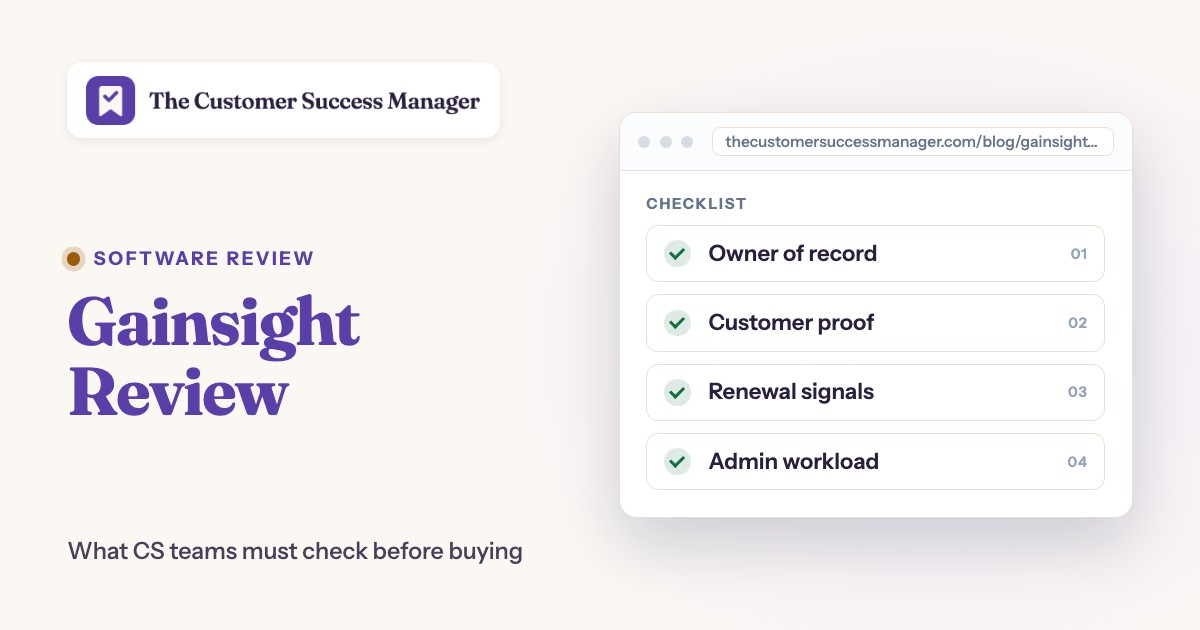
- Owner of record: name the person accountable for each customer commitment.
- Customer proof: define acceptable evidence that a promised outcome was delivered.
- Renewal signals: show which inputs drive risk and who reviews exceptions.
- Admin workload: identify who maintains data mappings, rules and playbooks.
- Handoff trace: follow a real Sales promise into a CS-owned action.
- Package scope: confirm included modules and limits against the written quote.
- Customer exception: demonstrate what happens when a journey should be paused.
- Reporting: show open commitments and overdue customer-facing obligations.
Data readiness and ownership
Data readiness is a prerequisite for meaningful Gainsight health and renewal workflows. Before purchasing, map the authoritative source for account identity, customer hierarchy, product usage, support history and commercial status. Decide which team resolves mismatches. If the source data isn't trustworthy, automation can spread an error faster than a manual process.
Ownership deserves its own review. The CS operations lead may administer the platform, but that doesn't make them responsible for every customer promise. Separate system configuration ownership from commitment delivery ownership and customer confirmation. When those roles blur, teams tend to close tasks without closing obligations. They don't see the difference until an unhappy customer asks for proof.
Implementation and change management
Gainsight implementation should be evaluated as an ongoing operating model, not a one-time software installation. Choose a small set of high-value motions, agree on the event that starts each one and decide what successful completion looks like. Build a controlled pilot before adding more data sources or journeys.
Training should cover how CSMs inspect a health signal, what they do when a CTA is wrong and when they should escalate an exception. A platform that creates more alerts than a team can interpret won't improve customer accountability. It can't replace judgment about a customer's needs. It's clearly better to run a narrow motion reliably than to launch every available module at once.
Gainsight alternatives and when to consider them
Gainsight alternatives are worth evaluating when a team needs a narrower CS motion, has limited administration capacity or wants a different approach to customer engagement. ChurnZero, Vitally and Planhat are sensible products to shortlist for a structured comparison, but this review doesn't assert feature or pricing superiority without a current side-by-side validation.
A buyer should ask each vendor to perform the same test: ingest an account, identify a risk, create an owned action, preserve the original customer commitment and show the proof that it was resolved. Score the demonstration on clarity, configuration effort and the quality of the handoff, not on the number of screens in the demo.
The narrowest alternative may be to improve your existing CRM workflow before buying another platform. If the main problem is missing commitment ownership rather than health modeling or journey orchestration, write down the required process first. The right software decision follows the operating requirement, not the other way around. You shouldn't need a new platform to clarify a basic ownership rule.
Gainsight review verdict: who should buy and who should wait?
Gainsight is a strong shortlist candidate for a mature CS organization that needs configurable account intelligence, structured interventions, success plans and coordinated renewal work. The case gets stronger when there is a dedicated owner for data quality, platform configuration and continuous improvement.
A smaller team should wait if it can't explain the exact customer workflow it wants to improve or can't staff the administration work. The better first move is to define commitments, owners and proof of delivery. Then test whether Gainsight meaningfully reduces the friction in that process.
Our verdict is conditional rather than universal: choose Gainsight when the depth of its post-sale workflow justifies the cost of running it; skip it when a simpler commitment process would solve the actual problem. A successful rollout makes it easier to answer who promised what, who owns the next action and whether the customer received the outcome. If it doesn't, the rollout hasn't solved the underlying CS problem.
Gainsight review FAQ
Is Gainsight good for customer success teams?
Gainsight is a strong fit for CS teams that need configurable health signals, playbooks, success plans and coordinated post-sale work. It can be too much operational overhead for a team without a clear owner for setup and data quality.
How much does Gainsight Customer Success cost?
Gainsight Customer Success uses request-based pricing for its Essentials and Enterprise packages. A buyer should request a written quote covering licenses, data limits, optional modules and implementation.
What are Gainsight's biggest drawbacks?
Gainsight's main evaluation risks are configuration complexity, data governance and the effort required to maintain useful automation. Public review feedback also points to a learning curve for administrators and users.
Does Gainsight replace a CRM?
Gainsight is designed around customer success operations and account context, not as a blanket replacement for every CRM workflow. Confirm where each record is mastered and how updates move between systems.
Can Gainsight track customer commitments?
Gainsight can organize goals, success plans, CTAs and customer interactions. Teams still need to define the original promise, accountable owner and evidence of customer acceptance to track a commitment reliably.