Gainsight vs Planhat comes down to how much structure you want built in and how much you want to model yourself. Gainsight is the more prescriptive platform: scorecards, a Cockpit of calls to action (CTAs), playbooks, success plans, Journey Orchestrator and, on the Enterprise package, renewal and expansion forecasting. Planhat leans toward a connected, adaptable data model that sales, success and service teams share, with health profiles you tune per segment and automations that now sit in an AI-enabled workflow studio. Neither vendor publishes a customer success price, so you'll settle the money question through quotes, not a pricing page.
G2 lists both platforms at about 4.5 out of 5, and its review summaries show the same complaint about both: a steep learning curve. Frankly, that's why the practical question is less about features and more about who will administer the system after the contract is signed.
Gainsight vs Planhat: the short verdict
 Choose Gainsight when
- Renewal and expansion forecasting is central and you can buy the Enterprise package.
- You want prebuilt CS constructs such as scorecards, CTAs, playbooks and success plans, and you have an admin to run them.
- You want AI that reads customer conversations for churn risk, through Staircase AI.
 Choose Planhat when
- Sales, success and services need one shared, flexible data model for customers and revenue.
- A CS ops person should tune health profiles per segment without a data scientist.
- You want unlimited view-only users and an open API in every plan.
Gainsight's own pricing page lists AI-assisted insights, Customer 360, playbooks, success plans, dashboards, health scorecards, surveys and digital journeys in its Essentials package. Planhat's pricing page lists dashboards, advanced security, an open API and custom fields with field rules in every plan. Those lists clearly show how each vendor frames its product, and it's a useful clue: Gainsight sells a set of named CS modules, while Planhat sells a platform with configurable parts.
| Tool | Health scoring | Customer action | Renewals | CRM connections | Users | Public price |
|---|---|---|---|---|---|---|
| Gainsight Customer Success | Scorecards with weighted measures, graded by number, letter or color | CTAs, playbooks, success plans, Journey Orchestrator | Renewal and Expansion Forecasting in Enterprise; Renewal Center documented as an add-on | Salesforce and HubSpot | 10 full users (Essentials) or 20 (Enterprise), unlimited viewers | Request pricing |
| Planhat | Health profiles per segment, scored 0 to 10 from a baseline of 5 | Automations and AI workflows, customer portals | Renewal process with automated forecasting and agents | Salesforce and HubSpot | Minimum core users, unlimited view users | Quote based, annual upfront |
What are Gainsight and Planhat?
Gainsight and Planhat are customer success platforms: software that brings account data, usage, conversations and renewals into one workspace so a customer success team can see which customers are at risk and act on it. Gainsight markets its offer as Gainsight CS with Staircase AI, and it also sells separate products on the same pricing page, including Skilljar, Gainsight PX and customer communities. Planhat positions itself around a unified commercial data foundation, with product areas for customer success, CRM and professional services automation.
That difference in scope shows up in buying. A Gainsight CS purchase is a choice between two named packages, which keeps it simple. A Planhat purchase is a platform fee plus a minimum number of core users, with plan tiers for its CRM and customer success products, so you'll need the vendor to confirm what's included in your configuration.
Customer data model
Planhat describes its data layer as one connected home for commercial data: CRM records, revenue, conversations, documents and time series. Health and adoption values are stored as time series rather than snapshots, which matters when you want to see how a score moved over 90 days instead of what it is today. Planhat's developer hub lists a REST API, agent and MCP access and its automations, and its pricing page includes the open API, custom fields and field rules in every plan.
Gainsight works from its own data architecture, and it's called Matrix Data Architecture. Its documentation describes system, standard and custom objects. Company, User and Relationship are standard objects, and administrators can edit the schema of custom objects and load or delete their data. That gives a CS operations team a lot of room, but it also means somebody has to own the schema.
A good test for either platform is a messy account, and it's cheap to run: a parent company with three subsidiaries, a duplicate record from the CRM and a contact who changed jobs. Ask each vendor to import that account from a spreadsheet, then show where the conflict surfaces and who can fix it.
Customer health scores
Here's where the two products feel most different in practice.
Gainsight Customer Success
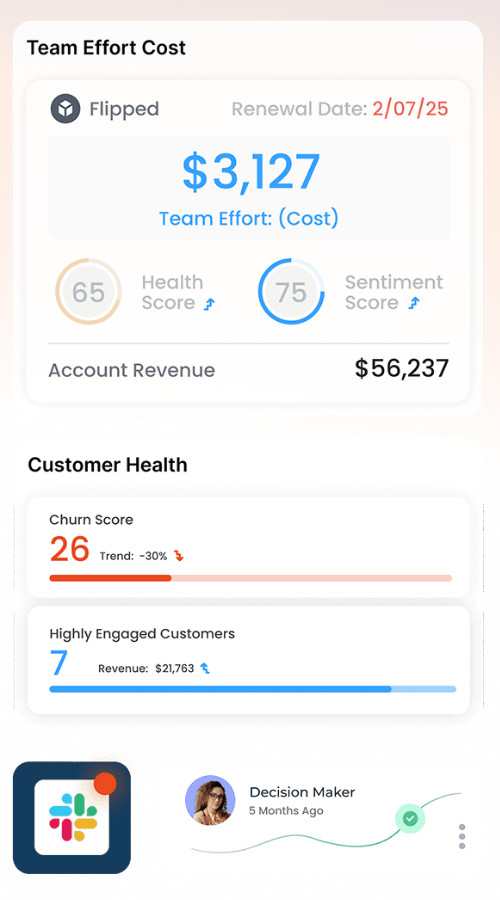
Gainsight computes health in two ways. Scorecards are a rules-based, weighted health score that admins configure, with AI suggestions for measures and weights. Staircase AI adds a communication-driven layer that reads emails, calls, tickets and meetings, flags churn risk events, and rates risk 1 to 5 with reasons and a playbook. It does not publish a churn probability or revenue-at-risk figure.
Gainsight scores health through scorecards: each dimension is a measure, measures roll up into groups, and scores are set manually or through a rules engine.
Gainsight's documentation says you can grade by number, letter or color, and that a customer or relationship can have only one scorecard assigned. That constraint's worth testing if you serve enterprise customers and small accounts with different success models, because segments will share one scoring structure per customer. Gainsight's Renewal Center reads these scorecard health scores for each company, and a machine learning model highlights the factors with the greatest impact on renewal.
Staircase AI adds a second layer. Gainsight says it analyzes customer conversations to surface churn risk and logs emails, support tickets, chats and meetings without manual entry.
- You want scorecards with weighted measures plus AI that reads customer communications for risk
- You have an admin or CS ops owner who can run a larger platform and route risk into CTAs and journeys
- You need a quick rollout: G2 reviewers flag a steep learning curve
- You need published pricing or a churn probability score; neither is published
- Users like
- centralized customer data, journey visibility, health scoring
- Users dislike
- a steep learning curve, non-intuitive navigation, limited customization
- Source: G2, 1,747 reviews
- Starting price
- Quote only (Essentials and Enterprise tiers)
- Risk method
- Weighted scorecard (rules) plus Staircase AI communication analysis
- Inputs
- Usage and CRM via scorecards; emails, calls, tickets, meetings via Staircase AI
- Refresh
- Risk summary about every 8 hours while risk is active
- Tiers
- Essentials and Enterprise; Staircase AI gating not published
- Vendor claim
- Up to 95% renewal forecast accuracy, as reported by Gainsight
- CS packages
- Essentials, Enterprise
- Essentials full users
- 10
- Enterprise full users
- 20
- CRM connectors
- Salesforce, HubSpot
- Published USD price
- Request pricing
- Renewals
- Confirm add-on entitlement
- Segment builder
- Journey Orchestrator segments from Salesforce or Matrix Data objects; 26 filters, 100,000 records per segment, 500 segments per tenant
- Segment refresh
- Only on a schedule you set; deletes and company merges are not reflected
Planhat
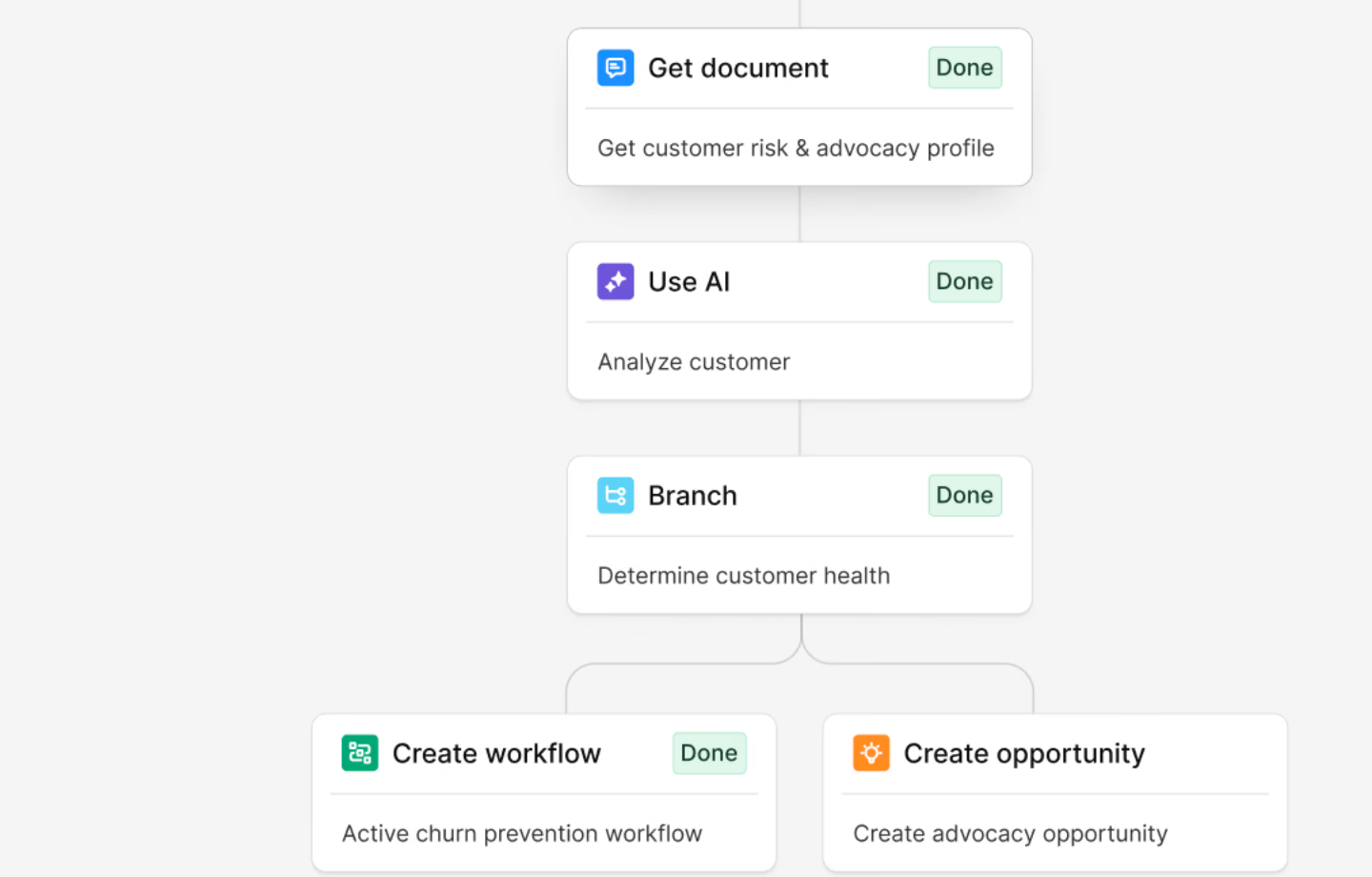
Planhat scores churn risk with rules you configure: health profiles built from usage, NPS, metric and field conditions, scored 0 to 10. AI adds sentiment from emails, chats and calls that can feed those scores. The AI overview does not describe a trained churn probability model, and the health article does not state refresh frequency.
Planhat scores health with profiles built per segment: conditions on usage, NPS, metrics and fields add or subtract points on a 0 to 10 scale.
Planhat's help center says the score starts at 5, factors add or subtract points and out-of-range values are clipped. It recommends between 2 and 8 factors. Group health is the mean average of the companies in the group, including the parent. Because profiles are defined per segment, a high-touch enterprise tier and a digital tier can use different models.
Planhat also describes sentiment (positive, neutral or negative) at company, end user and user level. Sentiment comes from emails, chats and calls and can feed health. Treat the score as a rules-based signal that you design.
- You want per-segment health profiles that a CS ops person can tune without a data scientist.
- You want email, chat and call sentiment to feed health scores and automations.
- You need a documented trained churn probability or revenue-at-risk model out of the box.
- You want published pricing or a team with no technical resources for configuration.
- Users like
- a clean interface, a flexible data model, responsive support
- Users dislike
- a steep learning curve, tricky integrations, occasional performance issues
- Source: G2, 926 reviews
- Starting price
- Quote only, no public USD price
- Scoring type
- Rules-based, 0 to 10, baseline 5
- Inputs
- Fields, metrics, NPS, usage, AI sentiment
- AI
- Sentiment and summaries, credit based
- Plan gating
- Not published; AI add-on listed
- Refresh
- Not published
- Pricing model
- Platform fee plus minimum core users; extra core users and add-ons
- Billing
- Annual upfront, USD by default
- View users
- Unlimited on all plans
The real trade-off is control against structure. Gainsight gives you a mature scorecard concept and an AI layer that reads communications. Planhat gives you a profile per segment and a rules model your team can tune quickly. Neither vendor publishes a validated accuracy figure for churn prediction, so you'll want to run the same test on both: feed in a customer whose usage dropped while the executive sponsor says things are fine, and see whether the CSM can explain why the score moved and override it with a documented reason.
Automation, playbooks and journeys
Gainsight's constructs are explicit, and they're easy to map to a CSM's day. Its documentation organizes work as tasks inside CTAs, playbooks as preset groups of tasks, and success plans as groups of objective CTAs, with plans starting as drafts until they become active in the Cockpit. Journey Orchestrator covers the one-to-many side: pre-built email templates, dynamic tokens, multi-step adaptive campaigns, renewal and QBR reminders and behavior-triggered sequences across email, in-app and CSM channels. Gainsight says the tool keeps CSMs in the driver seat.
Planhat's automation story is more open-ended. Its AI Workflows combine automations with AI steps, branching, delays, custom code and webhooks, with prebuilt templates. Automations now live in Pi Studio in Planhat OS, and Planhat's help center describes the Pi agent as a commercially oriented agent with memory and skills that can create signals from conversations of the last 30 days. Planhat's own materials say a process can range from a single automated step to an agent running a renewal motion.
If your team likes a named playbook library and a Cockpit where every CSM sees the same task queue, Gainsight maps closely to that mental model, and you'll recognize it quickly. If your team would rather assemble workflows from triggers, data conditions and AI steps, Planhat's building-block approach fits better. Yet the second path asks more of whoever designs the automations.
Renewals and forecasting
Gainsight's pricing page lists Renewal and Expansion Forecasting under the Enterprise package, and it doesn't list that capability for Essentials. Gainsight's Renewal Center documentation calls the module an add-on to the Customer Success platform, so you'll want to confirm in writing which package or add-on carries it before you compare quotes. According to the documentation, Renewal Center forecasts at the opportunity level, not by product line item, and it syncs with Salesforce, where opportunity records can be created from Gainsight. Viewer and analytics licenses can analyze and export, but they can't forecast or edit.
Planhat's renewal page describes automated forecasting, timelines, health scoring and embedded agents that handle nudges and risk summaries. Planhat publishes customer stories that report outcomes, such as an increase in gross revenue retention at one customer. Those are vendor-selected results, and they aren't independent benchmarks, so don't use them in a business case whatever the numbers look like.
If you're a renewal-heavy team that wants a dedicated forecasting module with manager and rep calls, Gainsight's Enterprise package is the more direct match, though it's worth confirming the entitlement. If forecasting should live inside a broader shared revenue model, Planhat's worth a close look.
AI features
Gainsight's AI story has three parts. Its pricing page lists AI insights and automations in Essentials. Staircase AI analyzes conversations for churn risk, and Gainsight says it holds ISO 27001 and ISO 42001 certifications with EU data center options. Atlas is a separate offer described as AI-native renewal service, where AI agents handle long-tail renewals alongside human renewal managers, and Gainsight describes outcome-based pricing for it.
Planhat's AI sits in the platform itself, and it's metered; you'll see credits consumed. Its AI steps can use Planhat's managed models or your own, and its help center says customer data isn't used to train them. AI credits are consumed by managed-model automation steps, sentiment and classification and conversation summaries, while connections to your own model don't use credits. The pricing page lists an Upgraded AI Platform as an add-on.
Whichever you pick, here's what to ask in writing, in four questions: which data the AI can read, whether a person approves customer-facing actions, how a summary traces back to its source message, and whether the AI feature is part of the quoted package or a separate charge.
Integrations
Both vendors connect to Salesforce and HubSpot, and that's not a tiebreaker. Planhat's integrations page also lists Segment, Snowflake, BigQuery, Zendesk, Mixpanel and Slack, and it lists an Anthropic integration for embedding Claude in workflows. Gainsight's marketplace lists Snowflake, Segment and Zendesk, among other connectors, and its Salesforce sync is documented for opportunity and renewal data.
A logo on an integrations page doesn't tell you how a sync behaves with your data. Ask each vendor to show you a failed sync, a merged CRM company and a changed account owner, and to say who sees the error.
| Data object | Source of truth | Who resolves a conflict? |
|---|---|---|
| Renewal date and amount | Contract or billing system | Revenue operations |
| Account owner | CRM | Sales leadership |
| Product usage | Warehouse or product analytics | Data owner |
| Health override | CS platform | Named CS leader, with expiry |
Security and data location
Gainsight's security page lists SOC 2 compliance, ISO 27001 certification, HIPAA and the Data Privacy Framework, but it doesn't name data center regions on that page and points to a separate trust site, so ask for region details in writing if you've got residency requirements.
Planhat says it's SOC 2 Type II certified and ISO 27001:2022 certified, with the report and certificate available under NDA, and it runs on Google Cloud. Its GDPR commitment page describes hosting of customer data on infrastructure in the EU and the US, with some sub-processors outside the EU covered by standard contractual clauses. Both vendors expect your security team to review the documents directly, so request current reports before shortlisting.
Gainsight vs Planhat pricing and total cost
Honestly, neither vendor publishes a dollar price for customer success software, and that's the main finding on pricing.
Gainsight's pricing page names two customer success packages and routes both to a request for pricing. Essentials includes 10 full users and 100 customers per user. Enterprise includes 20 full users and 200 customers per user, plus company news, renewal and expansion forecasting, and organizational mapping and sponsor tracking. Both include unlimited viewer licenses.
Planhat's pricing is quote based: a platform fee plus a minimum number of core users, with additional core users and solution extensions charged on top. Core users have full edit access while view users are unlimited in all plans, and billing is annual upfront, in US dollars by default. The four add-ons listed are an upgraded AI platform, advanced service, email marketing and advanced portals. Planhat also says paid onboarding and implementation plans are available and that a dedicated customer success manager is included in every plan, subject to a minimum annual spend.
The two structures aren't directly comparable. One is built on package allowances, the other on a platform fee and seat minimums. Ask both for a first-year quote on the same assumptions, since they won't volunteer a comparable one.
| Cost line | Gainsight | Planhat | What to confirm |
|---|---|---|---|
| Subscription | Package quote | Platform fee plus core users | Billing metric, term, annual uplift |
| Renewal forecasting | Enterprise, or add-on | Confirm scope | Entitlement in writing |
| AI | Confirm Staircase AI and Atlas | Credits plus AI add-on | Limits and overage |
| Implementation | Separate estimate | Paid plans available | Mapping, migration, training |
| Internal admin | Team hours | Team hours | Who owns configuration |
| Exit | Contract terms | Contract terms | Data export, notice period |
Implementation and administration
Gainsight offers Gainsight University with admin certifications and a community. Its Staircase AI page says setup can take as little as an hour, with one customer story citing a one-week implementation. Those are vendor claims about the AI layer, not the whole platform, so they can't tell you how long your CS platform rollout will take. Planhat, however, says all plans include an enablement library, certifications, live support, a community and a help center.
G2 reviewers point to the same weakness for both products: a steep learning curve. Gainsight reviewers also mention non-intuitive navigation and limited customization, while Planhat reviewers mention tricky integrations and occasional performance issues. Both products reward a team that's got a named administrator, but they punish a team that treats configuration as a side task.
- Renewal forecasting module with manager and rep callsGainsight Customer Success
- Playbook, CTA and success plan structure for a large CSM teamGainsight Customer Success
- AI that reads customer conversations for churn riskGainsight Customer Success
- One shared data model across sales, success and servicesPlanhat
- Per-segment health profiles tuned by CS opsPlanhat
- Unlimited view-only users and an open API in every planPlanhat
How to run the pilot
Run the pilot by giving both vendors the same account data and the same three tasks, and score what you see, not what they promise.
- Import a messy account set, including a duplicate and a parent-child pair, and show where the conflict appears.
- Build a health score for one segment, then change an input and explain the movement.
- Run a renewal with a changed sponsor and a discount request, and show who sees what.
Leave a cell blank when a feature wasn't shown. A promise in a demo isn't evidence, so it can't be scored.
When neither platform is the whole answer
Customer success platforms manage account signals and interventions, but that's a different job from recording promises. They don't automatically keep a verified record of what your team promised a customer during the sale or onboarding. If promises get lost between sales, CSMs and support, that's a narrower problem that either platform can leave open.
Frequently asked questions
Is Gainsight better than Planhat?
Gainsight isn't better than Planhat for every team. Gainsight fits teams that want prebuilt CS structure, renewal forecasting on the Enterprise package and AI that reads customer conversations. Planhat fits teams that want a shared, adaptable data model and per-segment health profiles. Test both on the same account data before deciding.
Which is cheaper, Gainsight or Planhat?
Neither Gainsight nor Planhat publishes a customer success price. Gainsight quotes two packages with user and customer allowances. Planhat quotes a platform fee plus a minimum number of core users, billed annually upfront. Ask both for a first-year quote on the same scope.
Does Planhat integrate with Salesforce and HubSpot?
Yes, Planhat integrates with Salesforce and HubSpot. Its integrations page lists both, along with Segment, Snowflake, BigQuery, Zendesk, Mixpanel and Slack. Confirm field mapping and sync direction for your data model.
Does Gainsight include renewal forecasting?
Gainsight's pricing page lists renewal and expansion forecasting under the Enterprise package, and its documentation describes Renewal Center as an add-on. Confirm the entitlement in your written quote.
How do Gainsight and Planhat health scores differ?
Gainsight and Planhat health scores differ in structure. Gainsight uses scorecards made of measures, graded by number, letter or color, with one scorecard per customer. Planhat uses health profiles per segment on a 0 to 10 scale that starts at 5. Gainsight scorecards and Planhat profiles are both rules based, and neither vendor publishes a validated churn prediction accuracy.
Are Gainsight and Planhat SOC 2 certified?
Gainsight lists SOC 2 compliance and ISO 27001 certification on its security page. Planhat says it's SOC 2 Type II and ISO 27001:2022 certified. Ask for the current reports and data residency details before you sign.
Final recommendation
Choose Gainsight if your priority is a structured CS operating system with renewal forecasting on the Enterprise package, and you've got an administrator who can run it. Choose Planhat if your priority is one flexible data model shared by sales, success and services, and you're ready to design health profiles and automations yourself. If both clear your pilot, compare written quotes on identical scope, because the pricing pages won't settle it and a demo shouldn't either.