Vitally pricing is quote-based. The official pricing page shows three packages, Tech-Touch, Hybrid-Touch and High-Touch, and every one of them says "Request Pricing." No monthly or annual dollar figure is published. This guide covers what the three packages are, what Vitally says every plan includes, and which terms to pin down in writing before you sign.
- Public list price: none. All three plans say Request Pricing.
- Plans: Tech-Touch (one-to-many and PLG), Hybrid-Touch (any model) and High-Touch (one-to-one, badged with unlimited full seats).
- Included in every plan: core features, unlimited automations, unlimited observer seats, single sign-on, the full integration library and unlimited Docs.
- Trial: the vendor offers a dedicated trial sandbox with your own data as part of the sales process, not as a self-serve free plan.
- Budget the subscription, onboarding, data work and admin time as separate lines.
How much does Vitally cost?
Vitally doesn't publish a price. The pricing page leads with "Three Plans, One Platform" and sends you to a demo request for the number. That means any per-seat or per-month figure you find on a marketplace profile or in a blog post is a guess, not a vendor rate, and shouldn't go into a budget as if it were one, and it definitely shouldn't reach Finance as a number.
What you can plan around is the shape of the offer, not a number. Vitally says its plans scale with your needs while sharing the same set of features, whatever customer success model you run. So the quote is driven by how you work, not by which features you unlock: account volume, how many people need full access and how hands-on your motion is.
When you ask for the quote, request these items in one document: the recurring subscription, currency, term, billing frequency, included seat types, onboarding scope and renewal conditions. If the seller offers a first-year discount, ask for the regular rate next to it. An introductory discount isn't a standing price, and it clearly shouldn't set your renewal budget, since you'll be paying the regular rate afterward.
Which Vitally plans are available?
Vitally describes Tech-Touch as designed for scaling with one-to-many and product-led customer success, Hybrid-Touch for scaling with any model of customer success, and High-Touch for one-to-one customer success. On the pricing page the High-Touch card carries an "Unlimited Full Seats" badge, and the other two don't.
- Tech-TouchRequest pricing quote only
- Built for one-to-many and product-led customer success
- Core features, unlimited automations and observer seats
- Single sign-on, full integration library, unlimited Docs
- Hybrid-TouchRequest pricing quote onlyAny CS model
- Built for scaling with any model of customer success
- Same shared feature set as the other plans
- Seat terms to be confirmed in the quote
- High-TouchRequest pricing quote onlyUnlimited full seats
- Built for one-to-one customer success
- Badged with unlimited full seats on the pricing page
- Same shared feature set as the other plans
Plan descriptions are taken from Vitally's pricing page as reviewed in November 2026. None of the three plans shows a dollar price.
The plan names describe a service model, not a size, and that's easy to miss. However, don't assume the High-Touch plan is the most expensive, or that Tech-Touch is the cheapest, until the written quotes arrive; the page never ranks them. The only structural difference the page itself draws is the unlimited full seats badge on High-Touch.
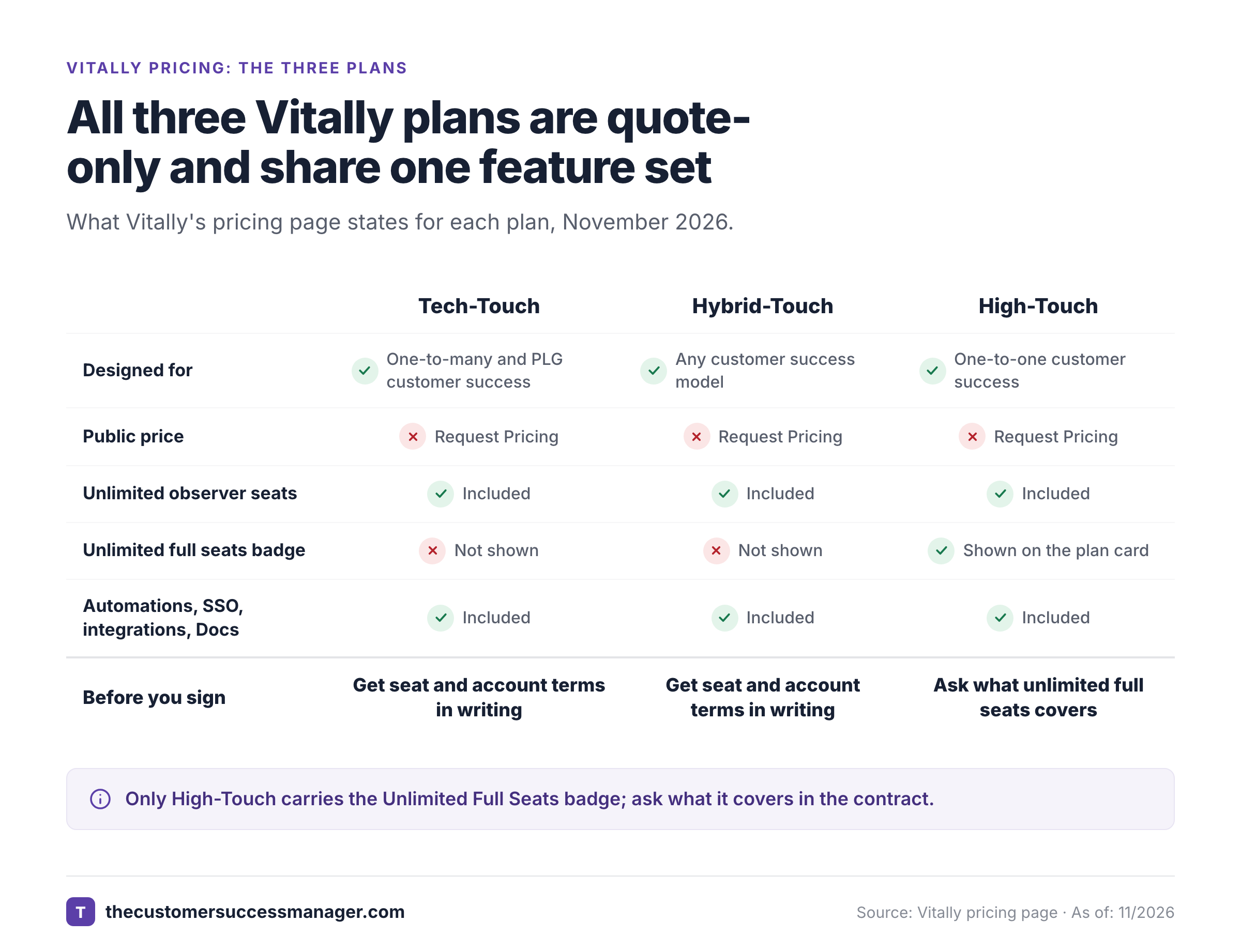
| Vitally plan | Designed for | Public price | Seat note on the page |
|---|---|---|---|
| Tech-Touch | One-to-many and PLG customer success | Request Pricing | Unlimited observer seats |
| Hybrid-Touch | Any customer success model | Request Pricing | Unlimited observer seats |
| High-Touch | One-to-one customer success | Request Pricing | Unlimited full seats badge, plus observer seats |
What's included in every Vitally plan?
According to the pricing page, every plan includes all core features, unlimited automations, unlimited observer seats, single sign-on, the full integration library and unlimited Docs. These are vendor statements about the packaging, not guarantees, so treat them as the starting point for contract language rather than proof of unlimited use in every dimension.
Two details deserve a question. First, "unlimited observer seats" isn't "unlimited working seats." Observers are for people who need to see data rather than work in it, but the quote should say exactly what an observer can and can't do. Second, "unlimited automations" only describes how many automations you can build. It doesn't tell you how many API calls or email sends you'll get, but those have their own limits.
What do observer seats mean for budgeting?
Observer seats are a way to give stakeholders visibility without buying a full license for every reader. A sales leader who checks account health once a week isn't the same cost as a CSM who works in the platform all day.
Map your roster before you talk to sales. Say you have ten CSMs, two operations admins and thirty sales and finance stakeholders who only consume dashboards. Ask for each group to be classified as full user, admin or observer in the order form, and confirm whether an observer can comment, edit or trigger actions. That's a staffing example, but it isn't a price.
How does Tech-Touch work?
Tech-Touch fits teams serving many customers through repeatable, automated journeys: onboarding emails, usage-triggered tasks, health changes and segment-based outreach. Vitally's own description pairs it with product-led customer success.
For a pilot, pick one segment with a measurable goal such as activation within 30 days. Document the trigger events, eligibility rules, message frequency and exception handling, then ask the vendor to run the workflow on a safe test dataset. The question for pricing isn't features but capacity: how many accounts and automated touches the proposed plan covers, since that is where a one-to-many motion grows fastest.
How is Hybrid-Touch different?
Hybrid-Touch is the plan Vitally positions for any customer success model. In practice that means automated journeys for low-risk segments and personal attention for accounts that need it or carry real revenue.
Although it sounds simple, a good test shows an account moving between those two tracks. Watch the handoff, who owns the task, and what history the CSM sees, instead of judging the demo by its dashboards. Ask whether segmentation rules, project templates and stakeholder communications work in the configuration you're quoted, because you'll want to verify those individually, never infer them from the plan name.
Who should consider High-Touch?
High-Touch is aimed at one-to-one customer success: enterprise portfolios, executive reviews, stakeholder notes and milestone-based plans for renewal and expansion. It's also the plan carrying the unlimited full seats badge, which matters if your whole team works in the platform every day.
Ask what the badge means in the contract, because a badge isn't a clause. Find out whether it covers every named user in your company or only customer success roles, and whether account caps apply instead. Unlimited seats can move the cost driver from headcount to something else, so you'll want that visible before you compare it with a per-seat competitor.
Does Vitally offer a free trial?
Vitally doesn't advertise a free plan or a self-serve trial price, which isn't unusual for quote-only vendors. The pricing page lists next steps after you contact sales: a personalized demo, a trial in your own dedicated sandbox with your customer data and team, and help building a business case for ROI.
So the trial is always part of the sales cycle, not a way around it. Before you load real customer data, agree on access rights, data handling, the deletion schedule and success criteria. Ask whether the sandbox is free, whether it needs an order form, and whether it'll convert to a paid subscription automatically.
Are annual and monthly payment options published?
No. The page doesn't contrast a monthly rate with an annual one, so don't build an annual equivalent out of a monthly price you invented, and don't treat a negotiated annual quote as a self-serve monthly option.
A usable comparison needs the subscription amount, currency, prepayment schedule, minimum term, renewal notice, seat growth rules and what happens if your headcount shrinks midterm. If a first-year discount appears, show the regular renewal price and its effective date beside it.
How much do setup and migration add to the bill?
Customer success platforms look simple in a demo, but they depend on clean account data. Implementation usually involves CRM mapping, billing identifiers, product-usage events, account hierarchy, historical notes, playbook triggers and reporting. The pricing page doesn't say which of those services each plan includes.
Vitally does say its customers go live faster than the industry average, quoting 1.9 months against 2.6 months on its own pricing page. That's a vendor statistic with no methodology shown, so use it as a prompt to ask for a written implementation timeline, not as a planning number.
Instead of a vague scope, make a checklist: who configures health scores, who imports data, who builds dashboards, who trains the team and who owns go-live QA. Record one-time services separately from the subscription, and don't assume onboarding is free unless the proposal says so. A modest license can still demand a lot of internal time, so don't stop at the subscription line.
What integrations does Vitally support?
Vitally's integration overview lists connections including Segment, Mixpanel, Salesforce, HubSpot, Stripe, Chargebee, Recurly, Jira, Zendesk, Intercom, Gmail, Gong, Outlook, Slack, Pendo, Amplitude, Looker, Zapier and data warehouses, plus a REST API and CSV upload. Every plan includes the full library, so integrations shouldn't be a pricing lever, though they're a real workload.
A listing isn't proof that each connection syncs every object, and it won't say which direction. Write a data-flow map for each integration you need: the account identifier, the source of truth, the refresh schedule, error handling and the deletion policy. One practical detail from the docs: if you disconnect and reconnect an integration, the old configuration is lost, so screenshot your settings first.
How do health scores affect the evaluation?
Vitally's help center describes multiple health scores per account, for example one for product usage and another for NPS. Each is graded on a scale of 0 to 10, the overall health is a weighted average, and different segments can have their own weights and conditions. The docs state scores are calculated hourly.
Those are documented functions, but they're not an independent accuracy benchmark. In a pilot, configure a handful of transparent inputs and check how nulls are treated, since excluded nulls are simply ignored. Ask the vendor to show why a given account got its score, and treat the number as a prompt for the CSM's next action rather than a churn prediction. It's a signal, not a forecast.
Does Vitally have an API?
Yes, there is one. The public REST API supports creating, updating, retrieving and listing Users, Accounts, Conversations, Tasks, Notes and NPS Responses, with API key authentication and cursor-based pagination. The default rate limit is 1,000 requests per minute using a token bucket, and write requests can count as more than one request.
That limit's useful for sizing a sync job. Ask whether API access is part of your proposed subscription, whether rate limits can be raised, and whether any of the objects you need are read-only. Don't wait until after signing to find out.
How should I compare Vitally with alternatives?
Compare tools on the same workflow, not on plan names. Build a requirements matrix with account hierarchy, playbooks, health scores, success plans, integrations, reporting and permissions, and give every vendor the same anonymized scenarios. If you're weighing the two largest names, our Gainsight vs Vitally comparison covers fit by team type, and the Gainsight pricing guide and ChurnZero pricing guide explain how those vendors quote.
Separate subscription from implementation and administration; they're different budgets. A strong demo can still hide expensive data cleanup, so weigh integration risk next to the quoted price.
How can I model Vitally's total cost?
Build a three-year model, even if the vendor only quotes one year, with separate lines for the subscription, onboarding, data preparation, integrations, migration, training and internal administration. Add growth scenarios for CSM headcount and account volume. Until the vendor responds, you shouldn't guess; write "quote pending" in the subscription row.
The calculator below is arithmetic, not a price list. Enter the annual subscription number from your own quote and it adds the setup assumptions you choose.
Illustrative arithmetic only. The $8,000 assumptions are placeholders, and none of the numbers are Vitally prices. Replace them with your own quote and internal costs.
What should a good Vitally quote include?
Ask for an order form that names the plan (Tech-Touch, Hybrid-Touch or High-Touch), total price, term, currency, permitted full seats and observers, account capacity, included integrations, API entitlements, support and onboarding. Ask about cancellation and auto-renewal clauses too.
Request two totals: the first-year commitment after any promotion, and the ordinary recurring commitment when it ends. If the seller offers a multi-year price cap, it belongs in the contract. Keep the quote date, because commercial offers change.
- Many customers served through automated, product-led journeysAsk for a Tech-Touch quote and test one segment in the trial sandbox
- A mix of automated and personal coverageHybrid-Touch, with the handoff between tracks demonstrated
- Every CSM and manager working in the platform dailyHigh-Touch, and get the unlimited full seats terms in writing
- A public price before talking to salesVitally doesn't publish one, so shortlist vendors that do
- Predictable renewal spendNegotiate a renewal cap and show the regular rate beside any discount
Frequently asked questions
Does Vitally publish a monthly per-seat price?
No. The official pricing page shows Request Pricing for Tech-Touch, Hybrid-Touch and High-Touch, with no dollar figures.
What are Vitally's plan names?
Tech-Touch for one-to-many and product-led customer success, Hybrid-Touch for any customer success model, and High-Touch for one-to-one customer success.
Do all Vitally plans include observer seats?
The pricing page lists unlimited observer seats as included in all plans. Confirm in your quote what an observer is allowed to do.
Does Vitally have a free trial?
Vitally has no self-serve free plan on its pricing page. It offers a trial in a dedicated sandbox with your own data as a step in its sales process.
What is Vitally's API rate limit?
The REST API documentation gives a default of 1,000 requests per minute. Write requests may count as more than one request.
Is an introductory quote the ongoing price?
Not unless the contract says so. Ask for the regular renewal price in writing and keep it separate from any first-year discount.
Sources
This guide draws on Vitally's pricing page, its integrations overview, its health scores help article and its REST API overview, all reviewed in November 2026. Vendor pages change, so you'll want to confirm every figure and term against your own written quote.