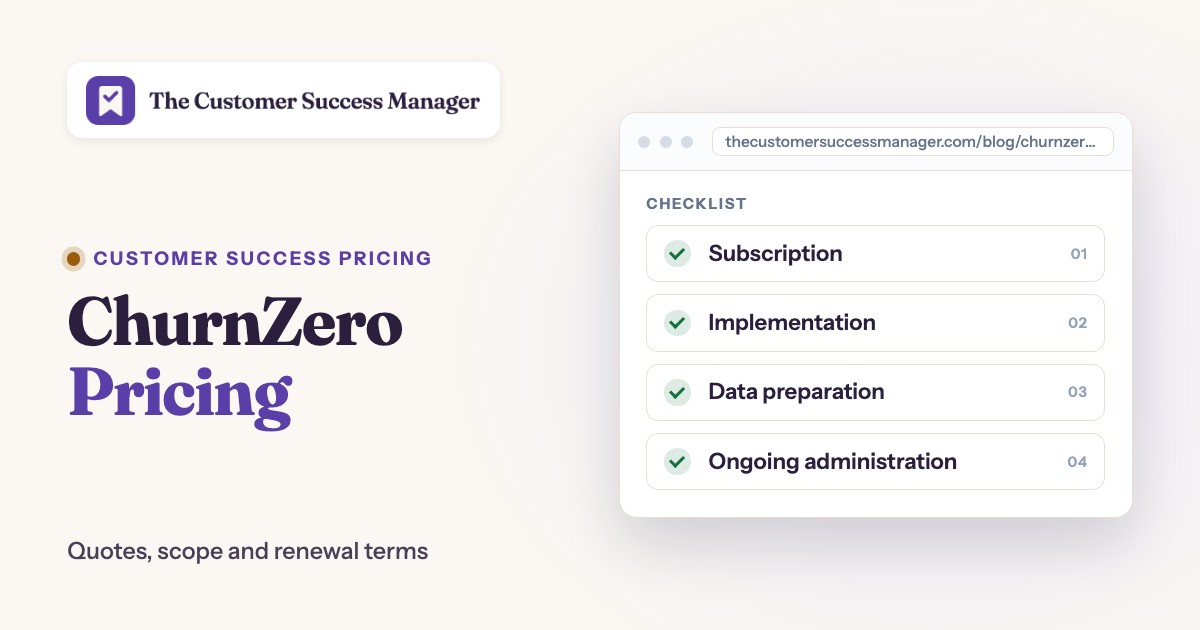
ChurnZero pricing is quote-based. The company doesn't publish a current US subscription rate card on the official product and demo pages reviewed in October 2026. Capterra lists a Basic starting price of $12,000 per year, but that third-party listing isn't a binding offer or a verified ChurnZero price. Treat it as a preliminary reference, but don't adopt it as your budget.
If you're building a business case, the bigger question is what the quote includes. Ask ChurnZero to define the licensed customer population, staff access, feature scope, implementation services and renewal terms in the order form. Its current published subscription terms include an automatic renewal with a default 45-day nonrenewal notice deadline, unless the order form says otherwise. That's materially different from the longer notice periods repeated in some third-party pricing guides.
- Official subscription list price: not publicly posted on the pages reviewed.
- Capterra's Basic listing: $12,000 per year, not a confirmed vendor quote.
- Vendor-specific quote: request a demo and a written order form.
- Default nonrenewal deadline in the October 2026 subscription terms: 45 days before expiration, unless your order form changes it.
- First-year budget: subscription plus implementation, data work, training and internal administration.
How much does ChurnZero cost?
There's no verified public ChurnZero list price that applies to every buyer. ChurnZero's official site directs prospective customers to a tailored demo rather than publishing a self-serve pricing calculator. Its subscription terms also refer to a signed order form that defines the purchased service, fees and subscription period.
You'll see several different figures online. Capterra's pricing profile displays a Basic entry at $12,000 per year. CostBench lists Professional and Enterprise as custom-priced tiers. Other comparison sites describe Essentials, Growth and Enterprise. Those catalogs don't agree on plan names. None should be treated as the vendor's confirmed current edition structure without a matching proposal.
One independent guide, Oliv.ai's February 2026 breakdown, describes negotiated contracts from $10,700 to $180,100 annually across different user counts and editions. That's a third-party estimate based on its reported procurement analysis, not a ChurnZero rate card. Other independent guides report narrower ranges for smaller customer success teams. Don't average those figures together, since the underlying populations, scopes and methods differ.
- ChurnZero subscriptionCustom quote Contact salesOfficial list price not published
- Customer health scoring and account views
- Plays, journeys and customer engagement
- Renewal visibility and reporting
- Confirm feature entitlements in the order form
The displayed subscription is not a published tier or fixed price. Capterra separately lists Basic at $12,000 per year; confirm any current offer directly with ChurnZero.
Budgeting judgment: don't use the Capterra figure as your approved purchase price. Use it to start a conversation, then require a complete, dated commercial proposal. If your team is comparing ChurnZero with Gainsight, see our Gainsight vs ChurnZero comparison for the operating-model differences.
If the quote does not fit, our ChurnZero alternatives guide compares seven other customer success platforms on packaging, setup time and who should skip each.
Why do ChurnZero price estimates disagree?
The pricing pages are answering different questions. A directory's starting price may describe a minimum package. A procurement marketplace may describe negotiated annual contract values. A consultant's estimate may include implementation and onboarding. Those are different scopes, even when every number is expressed in dollars per year.
Don't compare a directory's starting price with another vendor's all-in first-year estimate. Normalize the quote before making a recommendation to Finance.
| Price reference | What it can tell you | What it cannot establish |
|---|---|---|
| ChurnZero official demo and subscription pages | How to engage sales and where commercial terms live | A public, universally available USD list price |
| Capterra Basic listing | A displayed $12,000-per-year directory entry | Your negotiated package, scope or current availability |
| CostBench Professional and Enterprise entries | How one pricing directory groups possible packages | An authoritative current ChurnZero edition catalog |
| Oliv.ai negotiated-cost discussion | An indicative range described by a third party | A guaranteed quote or a reproducible price for your team |
| Your signed order form | The price, services and term you actually agree to | The cost of internal work not included in the contract |
The most useful next step isn't collecting more unverified averages, but sending vendors the same customer-account count, user-access requirements, integration scope and deployment target so you can compare like with like.
What changes your ChurnZero quote?
ChurnZero doesn't publish a formula for converting users, accounts or features into a final subscription price. Third-party buyer guides describe account volume, staff access, feature scope and contract length as common quote variables. Confirm which ones actually appear in your proposal instead of assuming a per-seat or per-account model.
Customer accounts and data scope
Define what counts as a managed account. Find out whether the limit is based on customers, subsidiaries, workspaces or another entity. Ask whether archived, churned and trial accounts count. If you have several products under the same customer organization, request a sample showing how the hierarchy is represented and billed.
It's also worth separating data storage from account volume. An account cap, event-volume allowance and API quota aren't interchangeable. The proposal should identify each billable meter, the included amount and the price of exceeding it.
CSM, administrator and stakeholder access
List every person who needs to sign in. Separate people who configure health scores and journeys from executives who only read reports. Don't assume view-only users are free, or that every employee needs a full license. Ask the vendor to document permission types and whether any user minimum applies.
Clarify how a seat is billed when a new account manager joins during the term, and whether added access is prorated, charged for the remaining term or handled through a contract amendment. A small difference in user policy can change your forecast without changing the core platform.
Features and packaging
ChurnZero publicly documents ChurnScores, customer plays, journeys, in-app communications, surveys, reporting and the Renewal and Forecast Hub. Its feature catalog also includes AI agents, Engagement AI and integrations. Public feature availability, however, doesn't prove that every feature is included in every quote.
Have the sales team mark each required capability as included, optional, separately priced or unavailable in the proposed package. Pay particular attention to digital engagement, advanced analytics, AI-related capabilities and integration access. A demo can show functionality, yet your contracted package may not include it.
Contract duration and services
The order form determines the initial subscription term. The published subscription terms say fees and incentives can change at renewal. Ask for the total committed amount, payment schedule, any proposed multi-year pricing and the rate or method that applies when the initial term ends.
Implementation is a separate scope question. ChurnZero maintains implementation documentation and offers consulting services under separate terms. A salesperson saying onboarding is included doesn't tell you whether your CRM mapping, data cleanup, health model design or staff training is covered.
ChurnZero first-year cost: a practical worksheet
Build a loaded first-year budget, not just a subscription comparison. That makes the approval request more realistic and gives you a basis for comparing vendors with different implementation models.
| Cost line | What to request in writing | Budget treatment |
|---|---|---|
| Subscription | Annual committed fee, included access and customer scope | Recurring vendor expense |
| Implementation | Statement of work, milestones, acceptance criteria | One-time vendor expense, if quoted |
| Data preparation | CRM cleanup, product-event mapping, account hierarchy fixes | Internal or third-party labor |
| Integrations | Standard connectors versus custom engineering | One-time and possible recurring costs |
| Enablement | Administrator training, playbook design, CSM rollout | Vendor services and internal time |
| Ongoing administration | Owner for data quality, automation changes and reporting | Internal recurring labor |
| Expansion allowance | Additional accounts, users or modules | Contingency, not assumed entitlement |
Illustrative arithmetic, not a ChurnZero quote: if a hypothetical subscription is $30,000, separately quoted implementation is $6,000 and internal data preparation is valued at $4,000, the first-year project total is $40,000 before any other costs. These inputs are assumptions chosen to demonstrate the calculation, not observed ChurnZero prices.
Illustrative arithmetic only. These are assumptions, not ChurnZero prices. Move the slider to test your own subscription figure.
Your finance model should also distinguish cash timing from expense recognition. A contract paid upfront can create a different cash-flow profile from one billed in installments even when the committed amount is identical. Ask Finance to classify services and internal labor using your own accounting policy.
Are implementation and onboarding included?
You can't determine the included implementation scope from the public feature catalog. ChurnZero's support center provides technical setup resources for integrations, APIs and data connections. Its legal pages distinguish subscription services from separately defined consulting services, with a statement of work used for purchased consulting work.
Don't assume that all setup carries an extra fee, either. A third-party guide might include a paid implementation estimate, but your particular proposal may include a defined onboarding package. Only the quote and services statement can settle that difference.
Before signing, get a deployment plan with an owner on each side. At minimum, ask the vendor to show how the following work will be delivered and accepted:
Map the customer record
Confirm CRM account hierarchy, account IDs, owner fields and the rules for merged or inactive customers.
Connect usage and support signals
Document the source systems, event definitions, data latency and how failed syncs will be detected.
Define health and intervention rules
Agree on the first health model, its inputs, alert thresholds and who can change automated plays.
Test customer-facing workflows
Use a nonproduction cohort to review segmentation, message timing, unsubscribe behavior and approvals.
Accept the rollout
Record working integrations, trained owners, reporting acceptance and remaining defects before the project closes.
The acceptance criteria matter because configuration isn't a one-time activity. If your product event names change or account ownership shifts, someone must update the system. A platform without a named internal administrator can turn into a set of dashboards that nobody trusts.
ChurnZero contract terms: renewal, notice and exit
The October 1, 2026 ChurnZero Subscription Service Terms contain concrete commercial details that deserve more attention than an unsourced discount estimate. These are the published default terms, not a substitute for your executed order form or legal advice.
Automatic renewal and the 45-day deadline
Section 4.1 says the subscription automatically renews for successive terms equal to the initial term unless the order form specifies otherwise. It requires notice of nonrenewal at least 45 days before the current subscription term ends.
Some independent pricing sites still repeat a 60 to 90 day cancellation window. That's not the default in the current official terms we reviewed. Your order form may modify the deadline, so use the executed contract as the controlling document. Ask your procurement team to enter the actual deadline in its renewal calendar as soon as the agreement is signed.
Fees may change at renewal
Section 5.2 says fees, discounts and other incentives are subject to change at renewal. The public terms don't promise a fixed renewal uplift or an automatic price cap. If predictable renewal spend matters, negotiate an explicit cap or renewal pricing schedule and have it appear in the signed order form.
Data retrieval after termination
Section 4.3 describes a 10-day window after expiration or termination for the customer to submit written instructions requesting access to or copies of customer data, or deletion, subject to the contract's qualifications. It also states that ChurnZero has no obligation to maintain customer data after the 30-day period that section refers to, so treat the 10-day request window as the practical deadline.
Don't wait until the final week of a contract to plan an export. Identify the data owner, test the export format and document how account notes, health-score history and other records will be retained outside the platform. The exact data deliverables should be confirmed with the vendor.
Where to send notice
Section 4.4 names accounting@churnzero.com for nonrenewal notices under Section 4.1. Confirm the contract's notice requirements with Legal, preserve delivery evidence and keep a copy with the renewal record. Sending a casual message to a CSM isn't a reliable substitute for the specified notice procedure.
How to negotiate a ChurnZero proposal
A clean scope gives you a stronger position than a speculative online price, which won't survive a real negotiation. If you can't explain what you're buying, it's hard to recognize an unfavorable concession.
Ask for a commercial schedule that Finance, CS Ops and the future renewal owner can all read.
- Separate recurring and one-time charges. A discounted subscription doesn't offset expensive services if those services weren't in the initial comparison.
- Fix the licensed population. Define active accounts, inactive accounts, user roles and the measurement date for any volume adjustment.
- List every feature in scope. Don't rely on a demo or a verbal assurance about AI, digital engagement, reporting or integrations.
- Protect the renewal. Ask for a price cap, a renewal notice reminder and a clear process for removing unused access before the next term.
- Control services scope. Use deliverables, acceptance criteria and change-order rates for integration and migration work.
- Negotiate the exit. Confirm export format, support for transition, data retrieval timing and what happens to records after termination.
If the vendor offers a multi-year discount, model the total committed cost against your realistic customer and staffing forecast. A lower annual rate can still be the wrong choice, especially when your product line or CS operating model is likely to change.
- Written annual subscription amount and billing schedule
- Current package names and feature entitlement list
- Definitions of managed customer accounts and licensed users
- Any minimum commitments, overage prices and expansion rules
- Implementation scope, statement of work and acceptance criteria
- Integration requirements and responsibility for data cleanup
- Administrator training, support levels and ongoing services
- Initial term, renewal period and controlling nonrenewal deadline
- Renewal price protections and process for changing scope
- Customer-data export method and post-termination responsibilities
ChurnZero versus other customer success platforms on price
ChurnZero, Gainsight and other enterprise-oriented CS platforms need comparable written quotes before you can rank them by price. A published starting figure for one vendor doesn't establish the cost of a deployment with your account count, workflow requirements and data sources.
Use a scenario-based comparison instead. Give each vendor the same required health signals, CRM structure, digital communication workflows, renewal reporting, security requirements and deployment deadline. Then compare the complete quote against the acceptance criteria.
| Buyer need | What to test | Why price alone isn't enough |
|---|---|---|
| Health-based CSM outreach | Health inputs, alert reliability and play ownership | A low fee won't help if signals aren't trusted |
| Digital customer engagement | In-app targeting, journeys and approval controls | Feature entitlement can differ from demo access |
| Renewal forecasting | Opportunity data, reporting ownership and audit trail | Forecasts depend on clean CRM and contract records |
| Lean CS team | Setup effort and ongoing administrator time | A platform can cost more in staff time than expected |
| Complex customer hierarchy | Account relationships and billing-meter definitions | Counting rules can change the commercial scope |
Our Gainsight pricing guide and Gainsight review cover adjacent buyer questions. For implementation planning, the customer success plan template provides a structure for turning promises into accountable work.
Who should buy ChurnZero at a custom price?
ChurnZero is a credible shortlist option when a customer success organization needs health scoring, automated plays, journeys, in-app communication and renewal visibility in a single operating platform. The vendor documents those capabilities publicly. The economic case depends on whether your team can maintain the underlying data and act on the signals.
It's a weaker fit when you're only trying to track a few customer commitments or need a public fixed-price checkout. You shouldn't buy an entire customer success platform to solve a narrow ownership problem unless the broader health, engagement and renewal workflows are part of your actual plan.
- Health scoring, plays and renewal visibility in one platformPut ChurnZero on the shortlist and request a scoped written quote
- A public fixed price before talking to salesChurnZero's official pages don't show one, so compare vendors that publish rates
- In-app messaging alongside CSM outreachAsk which engagement features sit in your package
- Predictable renewal spendNegotiate a renewal price cap in the order form
- Tracking a few customer promises and who verified deliveryA lighter commitment ledger may fit better than a full platform
For teams focused specifically on keeping promises visible, thecustomersuccessmanager.com offers a narrower customer commitment ledger: what was promised, who confirmed it, who owns delivery and whether completion was verified. It's not a substitute for ChurnZero's health scoring, playbooks, forecasting or CRM workflows. Access requires a code.
ChurnZero pricing FAQ
What is ChurnZero's starting price?
ChurnZero doesn't publish a verified universal USD starting rate on the official pages reviewed. Capterra lists Basic at $12,000 per year, but buyers should request a current vendor quote rather than treating that directory entry as an offer.
Does ChurnZero have monthly pricing?
The official public pages reviewed don't show a self-serve monthly price. Ask the sales team for the contracted subscription amount, billing cadence and minimum term.
Is there a free ChurnZero trial?
A self-serve free trial isn't advertised on the official pages reviewed. ChurnZero directs prospective buyers to a tailored demo. Its subscription terms allow introductory access in some circumstances, which isn't a promise of general availability.
How much is ChurnZero implementation?
There's no verified universal implementation fee. Request a statement of work showing data integration, health-model configuration, training, milestones and any separately billed consulting services.
Does ChurnZero renew automatically?
Yes, under the published October 2026 default terms, unless the order form says otherwise. The default nonrenewal notice deadline is 45 days before the current subscription term expires.
Can I cancel ChurnZero before renewal?
Review the signed order form and current subscription terms. A nonrenewal notice prevents the next renewal if it meets the controlling deadline; it doesn't automatically terminate an existing committed term.
The decision before you sign
Ask ChurnZero for a dated, fully scoped order form and a matching services statement. Check what counts as an account, who needs access, which features are included, who owns deployment and how the subscription renews. The current official contract language is a better source for notice timing than generic pricing roundups.
A defensible ChurnZero budget has three layers: committed vendor charges, implementation work and the internal capacity needed to operate the system. If those layers are explicit, you'll know whether the quote fits your team. If they're missing, you don't yet have a comparable price.