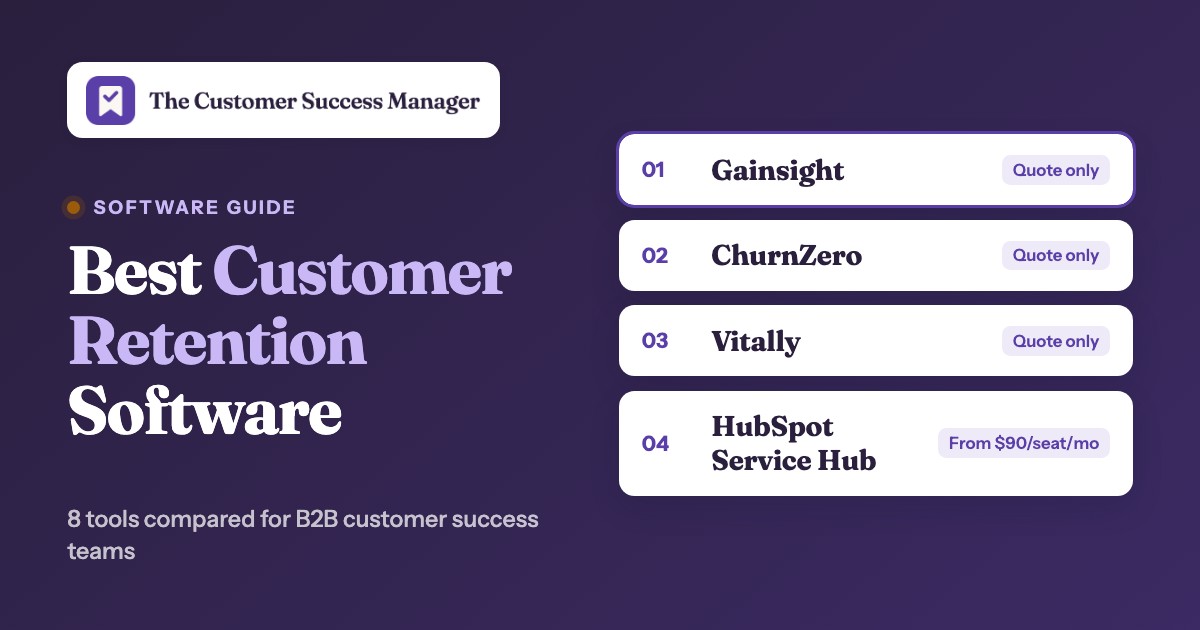
The best customer retention software for B2B teams is a customer success platform that scores account health, alerts the owner when risk shows up and tracks the renewal. Gainsight fits large books of accounts, while ChurnZero and Vitally fit mid-market teams, and HubSpot fits teams that already keep their customers in HubSpot CRM. This guide compares eight tools on how each one finds risk, who acts on it and what it costs.
It covers retention for B2B subscription and SaaS accounts, the work of a customer success manager. It leaves out consumer loyalty programs and e-commerce email tools, which solve a different problem.
- tools compared
- 8
- of 8 publish a price
- 3
- G2 rating range
- 4.3 to 4.7
- G2 reviews behind the ratings
- 10,000+
Best customer retention software at a glance
 Best for large books of accountsGainsightRule-driven scorecards create risk tasks for each CSM, and Enterprise adds renewal forecasting.
 Best for mid-market CS teamsChurnZeroChurnScores, alerts, plays and renewal forecasts in one tool.
 Best for segment-specific health scoresVitallyHealth scores and playbooks run hourly, with unlimited automations on every plan.
 Best if your data lives in HubSpotHubSpot Service HubHealth scores are built on the CRM records your team already uses.
 Best for small SaaS teamsCustifyA guided four-week onboarding and AI churn-risk scoring on conversations.
 Best for product-led retentionUserpilotReaches low-adoption users inside the product, not at account level.
 Our product · for the promises between toolsThe Customer Success ManagerKeeps the commitments your team made to each customer, which none of the tools above track.
| Tool | Type of tool | What it handles | Starting price (USD) | G2 rating |
|---|---|---|---|---|
| Gainsight | Enterprise customer success platform | Scorecards, risk CTAs and renewal forecasting | Custom, no public price (Essentials and Enterprise, quote only) | 4.5 (1,600) |
| ChurnZero | Mid-market customer success platform | ChurnScores, alerts, plays and renewal forecasts | Custom, no public price (book a demo) | 4.7 (1,600) |
 Totango (now Odie) | Enterprise customer success platform | Risk status, SuccessPlays and AI renewal-risk models | Legacy Totango: custom. Odie: from $500 or $1,500 per month | 4.3 (1,150) |
| Vitally | Mid-market customer success platform | Health scores and hourly playbook automations | Custom, no public price (three plans, quote only) | 4.5 (700) |
 Planhat | Enterprise customer success platform | Health profiles, automations and a flexible data model | Custom, no public price (quote only, add-ons quoted separately) | 4.5 (950) |
| Custify | Customer success platform for SaaS | Health scores, alerts and AI churn-risk scoring | Custom, no public price | 4.7 (500) |
| HubSpot Service Hub | CRM-native service and customer success suite | Customer success workspace, health scores and playbooks on CRM data | From $90 per seat per month on Professional, plus a $1,500 one-time onboarding fee | 4.4 (2,900) |
| Userpilot | In-app engagement and product analytics | Segment-triggered in-app flows, surveys and retention reports | $299 per month (Starter, up to 2,000 MAU), Growth from $849 per month | 4.6 (950) |
| The Customer Success Manager Our product | Customer commitment tracking | Records what your team promised each customer and whether delivery was verified | Access code | No reviews yet |
Prices as published by each vendor and checked on October 17, 2026. Quote only means the vendor shows no price. G2 ratings and review counts are rounded.
What is customer retention software?
Customer retention software uses customer data to show which accounts are at risk of leaving and starts the follow-up that keeps them. In B2B, that means a health score per account, an alert to the account owner when the score drops, and a view of upcoming renewals.
Four kinds of tools get sold under this label, and each solves a different problem.
- Customer success platforms (Gainsight, ChurnZero, Totango, Vitally, Planhat, Custify) score account health, create risk tasks and track renewals.
- CRM-native suites (HubSpot Service Hub) add health scores and renewal tracking to the CRM where deals and tickets already live.
- Product engagement tools (Userpilot) reach users inside the product when usage drops.
- Support desks and survey tools feed ticket and satisfaction data into the other three, but they aren't retention tools on their own. Teams that also need a help center or an internal wiki can compare eight options in our guide to knowledge base software.
Most B2B teams need one tool from the first or second group, and a self-serve product adds one from the third. Still, one platform is where to start.
Is a CRM the same as customer retention software?
No. A CRM stores contacts, deals and tickets, while customer retention software scores account health and starts the follow-up work. A small team can keep track of its customers in a CRM, and HubSpot Service Hub adds health scores to one. A dedicated platform such as Gainsight or ChurnZero pays off once you need risk scores from several data sources and a renewal forecast across many accounts. If you're a beginner, start in the CRM you already use.
How is a health score calculated?
Most tools add up weighted signals. ChurnZero gives each scoring factor points that total 100 and grades the result red, yellow or green. Vitally scores each category from 0 to 10 and averages the categories with weights, recalculating every hour. HubSpot assigns points to event groups such as support tickets and NPS, with caps and decay. Start with two or three signals you trust, such as product usage, support tickets and NPS, and add more after you see which ones predicted a lost renewal.
Where each tool fits in the retention cycle
Retention work follows one cycle: spot the risk, reach the right person, run the renewal and check that what you promised was delivered. Each tool owns one or two steps, and the risk sits in the handoff between them.
- Step 1Spot the risk
- ChurnZero
- Totango (now Odie)
- Vitally
Breaks when a usage feed goes stale, so the score looks healthy while the account goes quiet - Step 2Reach the user
- Userpilot
- Custify
Breaks when the message goes to a user who no longer has a say in the renewal - Step 3Run the renewal
- Gainsight
- HubSpot Service Hub
- Planhat
Breaks when the renewal date sits in the CRM and the forecast sits in another tool - Across allCheck what you promised
- The Customer Success Manager
Catches the commitment made on a call that nobody wrote into a task
The 8 best customer retention tools, reviewed
Each entry opens with who the tool fits, then lists when to choose it and when to skip it. The expandable part shows how the tool handles retention in practice. G2 notes are the most common themes in reviews, not our own testing.
Gainsight
Gainsight
A rule-driven customer success platform that turns health scorecards into risk tasks for each CSM and adds renewal forecasting on its Enterprise plan.
The most complete option for a large book of accounts, but it expects a dedicated admin.
- you manage a large book of accounts and want scorecards that create risk tasks for CSMs automatically
- you need renewal and expansion forecasting and have several CSMs: the Enterprise plan includes 20 full users
- you have no CS operations or admin owner: scorecards and risk tasks are built with rules, and setup complexity is the most common complaint in G2 reviews
- you need a published price before talking to sales: both plans are quote only
- Users like
- centralized customer data and health monitoring that is easy to see at a glance
- Users dislike
- complex, time-consuming setup and customization
- Source: G2, 1,600 reviews
How it works in practice
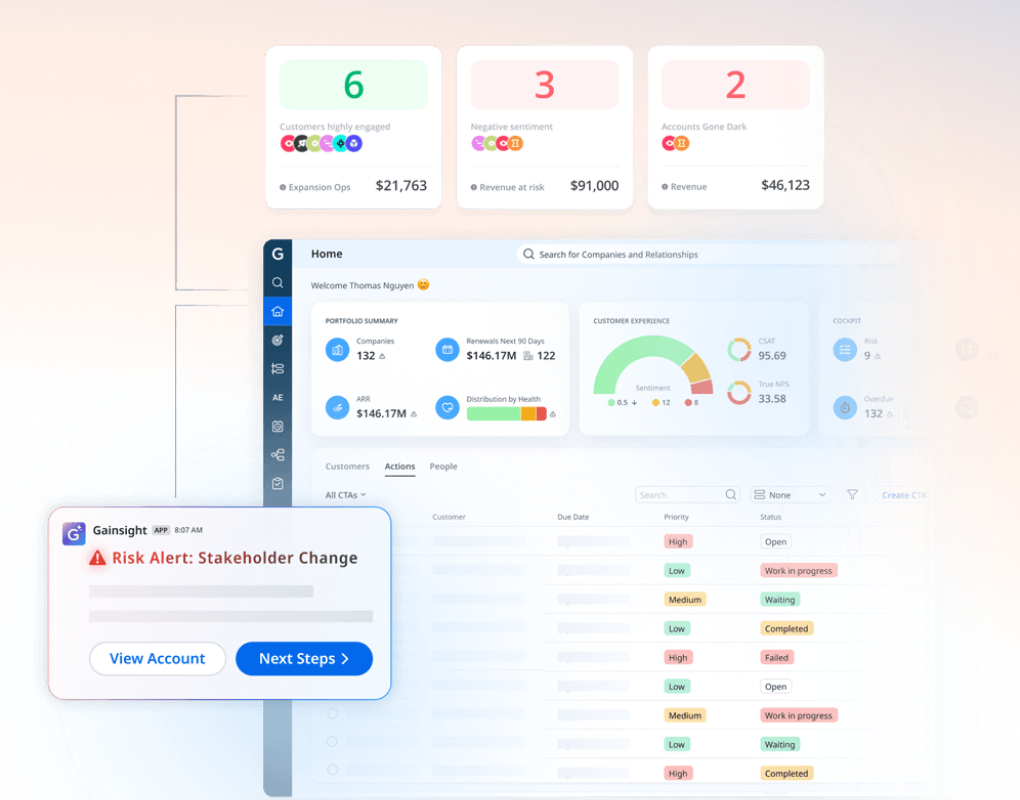
An admin defines scorecard measures, each scored by hand or by the Rules Engine. A rule can look for companies whose support measure turned red and create a call to action (CTA) of type Risk with high priority. The CTA lands in Cockpit, the CSM's work queue, with the playbook tasks attached to that CTA type.
Journey Orchestrator can send emails based on health score, product usage or survey results, and Renewal Center flags renewals that are likely to churn with a renewal likelihood score. Renewal and expansion forecasting, company news and sponsor tracking are Enterprise only.
Gainsight lists connectors for support tools such as Zendesk and Freshdesk, for Jira, Gong, Segment and Mixpanel, and for warehouses such as Snowflake and BigQuery.
- Starting price
- Custom, no public price (Essentials and Enterprise, quote only)
- Plans
- Essentials and Enterprise
- Seats included
- 10 full users (Essentials), 20 (Enterprise)
- Renewal forecasting
- Enterprise only
ChurnZero
ChurnZero
A customer success platform built around ChurnScores that alert the CSM when an account's score changes and start automated plays.
A mid-market platform that puts the score, the alert and the follow-up play in the same place.
- you want health scores, alerts, plays and renewal forecasting in one tool for a mid-sized CS team
- your stack is CRM, support and product usage heavy and you need many ready-made connectors
- you need highly flexible custom reporting: G2 reviewers describe dashboards with limited design options and a learning curve
- you want a self-serve start or a published price: ChurnZero publishes neither
- Users like
- ease of use and helpful customer support
- Users dislike
- a learning curve, plus limited dashboard and reporting flexibility
- Source: G2, 1,600 reviews

How it works in practice
A CS leader builds a ChurnScore from factors such as usage, engagement, support history, NPS and journey progress. Each scoring factor carries points, the points total 100, and the score is graded red, yellow or green in thirds by default, adjustable with sliders. Scores can differ by customer size, lifecycle stage, industry or region.
When a score changes, ChurnZero alerts the CSM and can start a play: a trigger-based sequence of tasks, emails, in-app messages and walkthroughs. CSMs can approve accounts into a play or remove them. Renewal Hub then forecasts renewals in dollars with ChurnScores shown next to each one and syncs with the CRM every 15 minutes.
The vendor's integration list includes Salesforce, HubSpot, Zendesk, Intercom, Pendo, Segment, Snowflake and Stripe.
- Starting price
- Custom, no public price (book a demo)
- Scoring
- ChurnScores, 100 points, red/yellow/green
- CRM sync for renewals
- every 15 minutes
- Integrations
- 70+ listed on the vendor site
Totango (now Odie)
Totango (now Odie)
A long-running customer success platform that rebranded to Odie in September 2026 and now sells an AI customer knowledge engine next to the legacy product.
A long-running platform with built-in risk workflows, now in transition: the vendor says Totango has become Odie.
- you want rule-based risk workflows out of the box, with risk stages, reasons and plays for utilization drops and champion loss
- you want AI renewal-risk prediction without seat pricing: Odie's Customer Operating System is priced by portfolio size
- you need one stable product name and roadmap: the vendor says Totango has become Odie and is moving toward an AI knowledge engine
- you want a published price for the legacy platform: Totango and Catalyst contracts are quote only
- Users like
- ease of use, support and a Salesforce sync reviewers call a standout
- Users dislike
- a steep learning curve and limited customization beyond Salesforce
- Source: G2, 1,150 reviews
How it works in practice
In the legacy platform you model accounts in the Data Modeler and define a Risk Status attribute with the default stages At Risk, Plan in Place, Saving, Closed-Recovered and Closed-Lost, plus a multi-select Risk Reason. SuccessPlays fire when an account enters or leaves trigger criteria such as a large drop in license utilization, high support-ticket volume, champion loss, payments 45 to 90 days past due or low NPS or CSAT, and create tasks for the CSM.
Odie's newer Customer Operating System re-evaluates each customer daily from CRM, usage, email, call and meeting data and uses predictive models for renewal risk to tell each CSM which accounts need attention that day. It's priced by portfolio size, not by seat. Totango's own homepage and a CEO letter dated September 10, 2026 say legacy customers keep their contract, pricing and product for now.
Check which product you're buying before you compare it with the others in this list.
- Starting price
- Legacy Totango: custom. Odie: from $500 or $1,500 per month
- Odie Knowledge Engine
- from $500 per month
- Odie Customer Operating System
- from $1,500 per month
- Health rank
- Good, Average or Poor, calculated daily
Vitally
Vitally
A customer success platform where health scores and playbooks run on the same hourly clock, with every plan including unlimited automations.
A mid-market platform where health scores and playbooks run on the same hourly clock.
- you want a health-score drop to start a playbook without paying for a higher tier: all plans include unlimited automations
- you run different health models for different segments, such as new and established accounts
- you need real-time scoring: scores and playbooks run hourly, so an action can lag a trigger by up to an hour
- you need a price to budget with before talking to sales: all three plans say Request Pricing
- Users like
- ease of use, a customizable interface and playbook automation
- Users dislike
- complex, time-consuming setup and integrations that need workarounds
- Source: G2, 700 reviews
How it works in practice
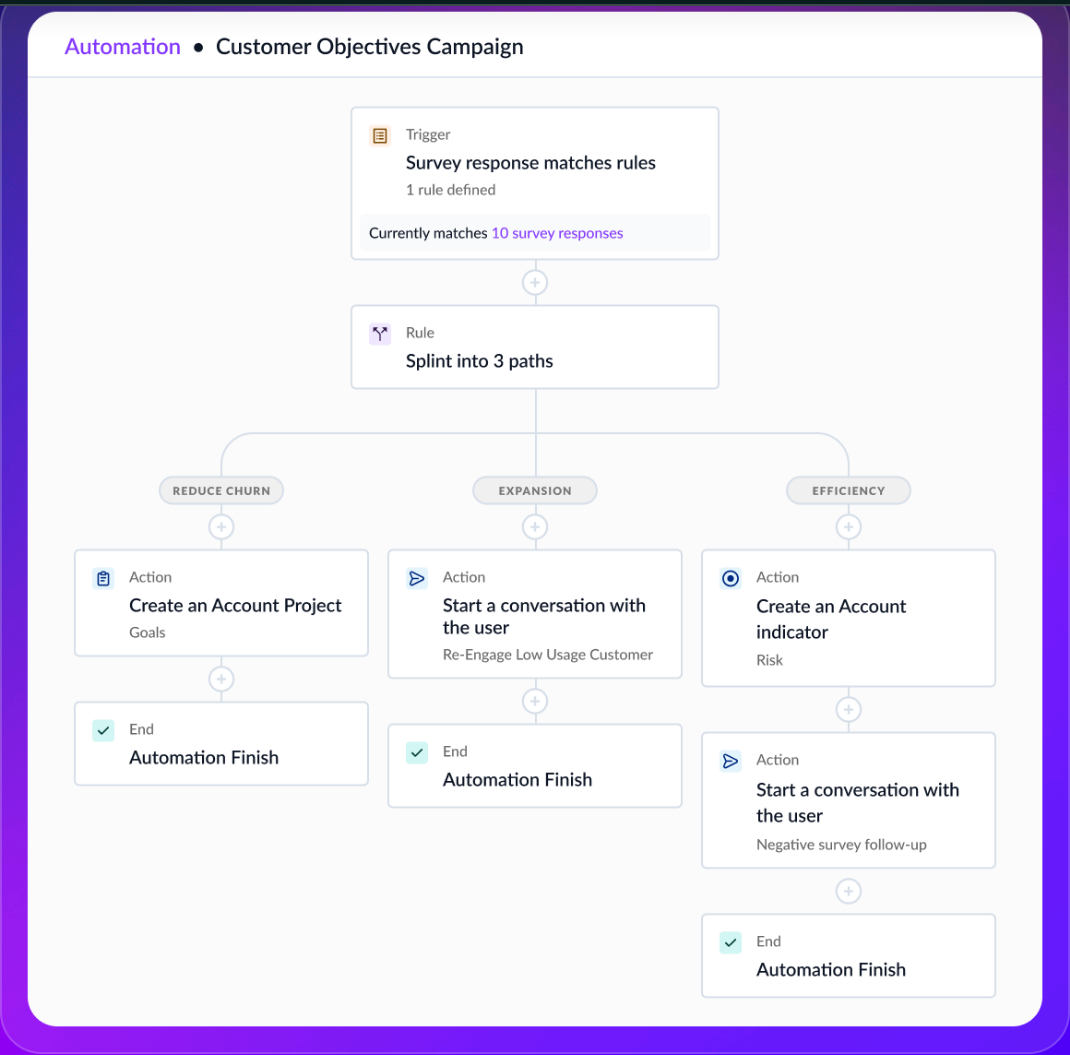
Data flows in from your product, CRM, billing and support tools. Admins define health scores on a 0 to 10 scale per category, with the overall score a weighted average, and can use different equations for different segments. Scores recalculate hourly.
Playbook automations also evaluate hourly. When a health score drops, a trait changes (for example Stage becomes Renewal), an NPS response arrives or an account enters a segment, the playbook can flag a risk, create tasks or projects, start a conversation or post to Slack. Run limits and exit rules control whether an account can re-enter a playbook.
The docs say all plans include unlimited automations, SSO and the full integration library, and the plans differ by customer success motion: Tech-Touch, Hybrid-Touch and High-Touch.
- Starting price
- Custom, no public price (three plans, quote only)
- Plans
- Tech-Touch, Hybrid-Touch, High-Touch
- Health score refresh
- hourly
- Automations
- unlimited on all plans
Planhat
Planhat
A flexible customer platform that holds companies, contacts and usage metrics in one data model and fires automations when health changes.
A flexible data model for high-touch enterprise teams that want to build health from usage metrics, though it takes work to set up.
- you run a high-touch enterprise motion with several data sources and want health built from usage metrics per segment
- you want automations with branching, wait steps and AI steps, and have someone to build them
- you have no admin or ops resource: reviewers cite a learning curve and long setup
- you need a published price: Planhat shows none, and add-ons such as the AI platform and portals are quoted separately
- Users like
- an intuitive interface and flexible data modeling that lets small teams manage large books
- Users dislike
- a learning curve and long setup, with occasional integration challenges
- Source: G2, 950 reviews
How it works in practice
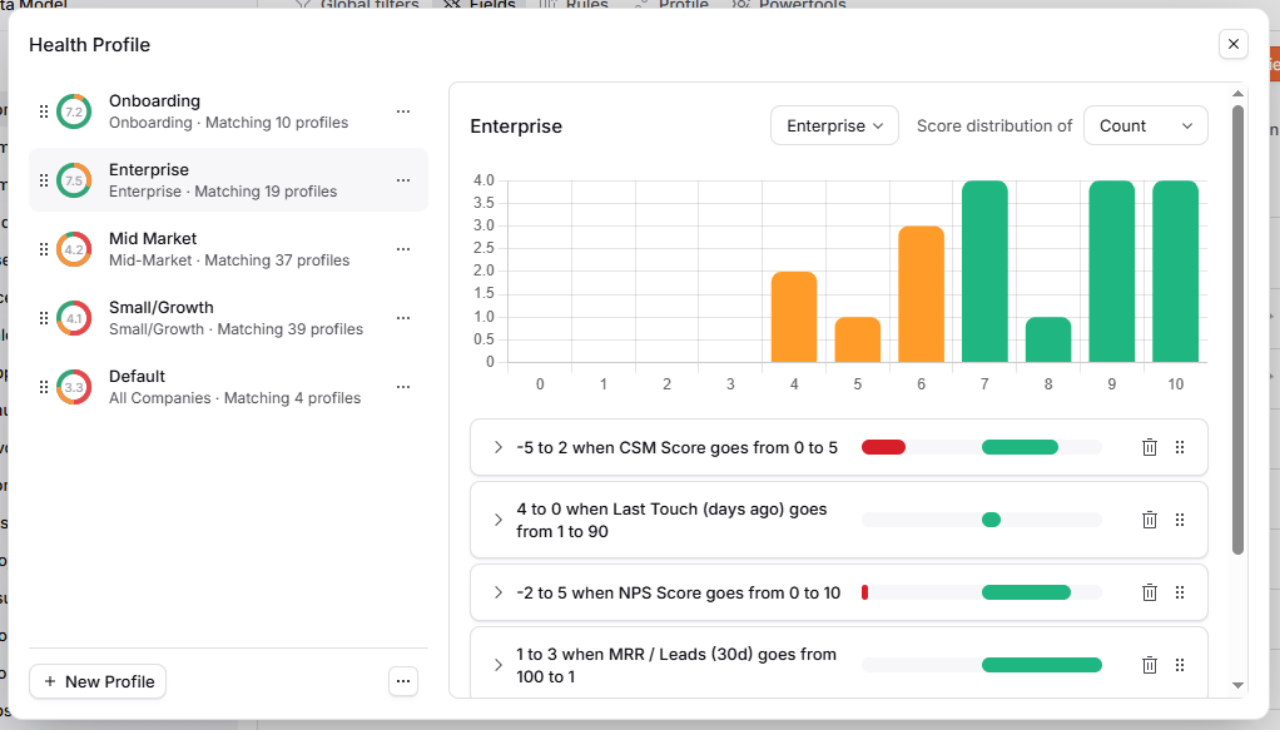
Planhat keeps companies, contacts and time-series usage metrics in one data model. A Health Profile applies rules to a segment, for example enterprise accounts in onboarding, and adds or subtracts points from the company health score. A company has one profile at a time and the first matching profile in the list wins. The help center warns that changing a profile can move many scores at once and trigger automations.
Automations come as templates in a sentence-style editor or as custom flows with branching, wait steps, webhooks and AI steps. A health score crossing a threshold can post to Slack, create a task or create an opportunity. Owners can also be notified in the app, by email, in Slack or Teams, or on the desktop.
Planhat lists Salesforce, HubSpot, Zendesk, Snowflake and BigQuery among its integrations.
- Starting price
- Custom, no public price (quote only, add-ons quoted separately)
- Health scoring
- profiles per segment, first match wins
- Automations
- templated or flowchart editor
- Notifications
- in-app, email, Slack, Teams, desktop
Custify
Custify
A customer success platform for small and mid-size SaaS teams that combines health scores and playbooks with AI churn-risk scoring on conversations.
A customer success platform aimed at small and mid-size SaaS teams that want to be live within weeks. It's lighter than Gainsight or Planhat, although G2 reviewers miss some basic features.
- you are a small or mid-size SaaS team that wants health scores, alerts and playbooks live quickly, with a guided four-week onboarding
- you want AI churn-risk scores on email and meeting conversations on top of playbooks
- you need a deep enterprise data model: G2 summaries cite missing basic features and limited customization
- you need a published price or a self-serve trial: Custify shows neither
- Users like
- ease of use and responsive support
- Users dislike
- missing basic features and limited email customization
- Source: G2, 500 reviews
How it works in practice
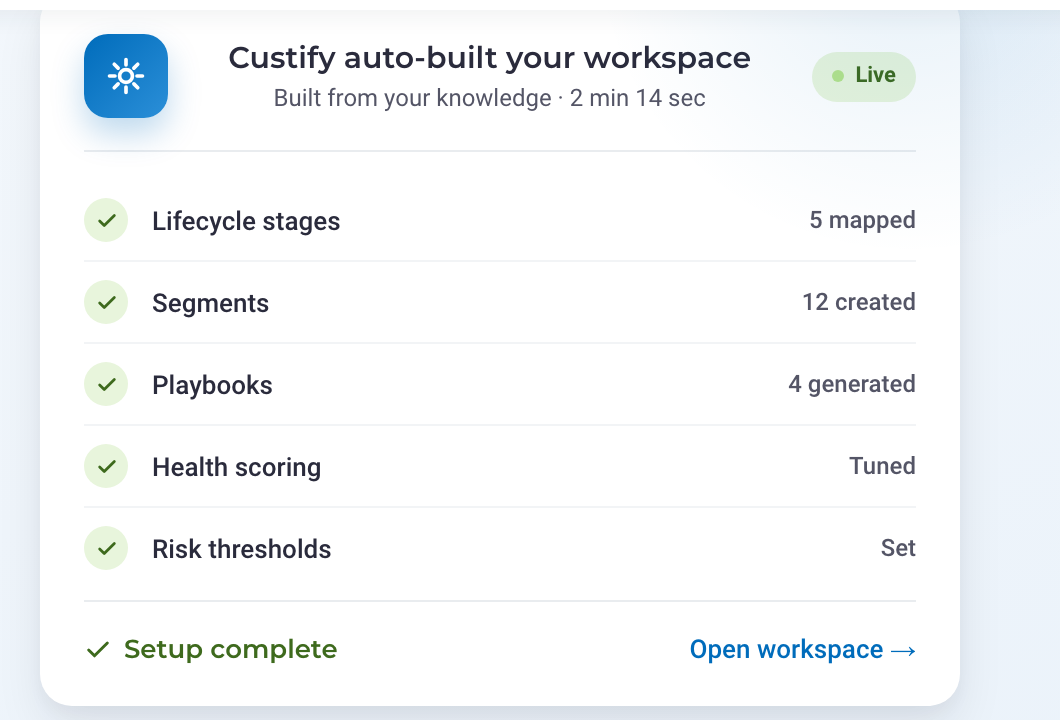
Custify pulls data from CRM, billing, product usage and support tools into a customer view with calculated metrics. CSMs define weighted health scores and custom alerts. When a trigger fires, the alert can post to Slack, send an email or create a task for the CSM. Playbooks then run steps such as emails, surveys, tasks or customer-portal actions.
CustifyAI adds an AI decision step to automations, scores churn risk from 0 to 100 per conversation and tracks sentiment trends over time. It can also draft a playbook from a typed scenario and add AI summaries to scheduled renewal and QBR playbooks. The vendor promotes a four-week guided Concierge Onboarding, states that data is stored in Germany and lists GDPR and ISO 27001.
Its integrations include Salesforce, HubSpot, Intercom, Segment, Stripe, Chargebee, Gong and Slack.
- Starting price
- Custom, no public price
- Onboarding
- 4-week guided Concierge Onboarding
- AI
- churn-risk score 0 to 100 per conversation
- Data location
- Germany, GDPR and ISO 27001 stated
HubSpot Service Hub
HubSpot Service Hub
HubSpot's customer success workspace builds health scores, alerts and renewal tracking directly on the CRM records your team already uses.
The practical choice when your deals, tickets and contacts already live in HubSpot CRM.
- your deals, tickets and contacts already live in HubSpot CRM, so health scores need no integration
- you want a transparent, rules-based health score you build yourself and one workspace for tasks, alerts and renewals
- you have a large CS team on a tight budget: each Service Seat starts at $90 per month plus a $1,500 onboarding fee, and the features are not on Free or Starter
- you need predictive churn analytics or several health scores: those are Enterprise only, from $150 per seat
- Users like
- ease of use and the CRM integration
- Users dislike
- missing features, limited customization and cost
- Source: G2, 2,900 reviews
How it works in practice
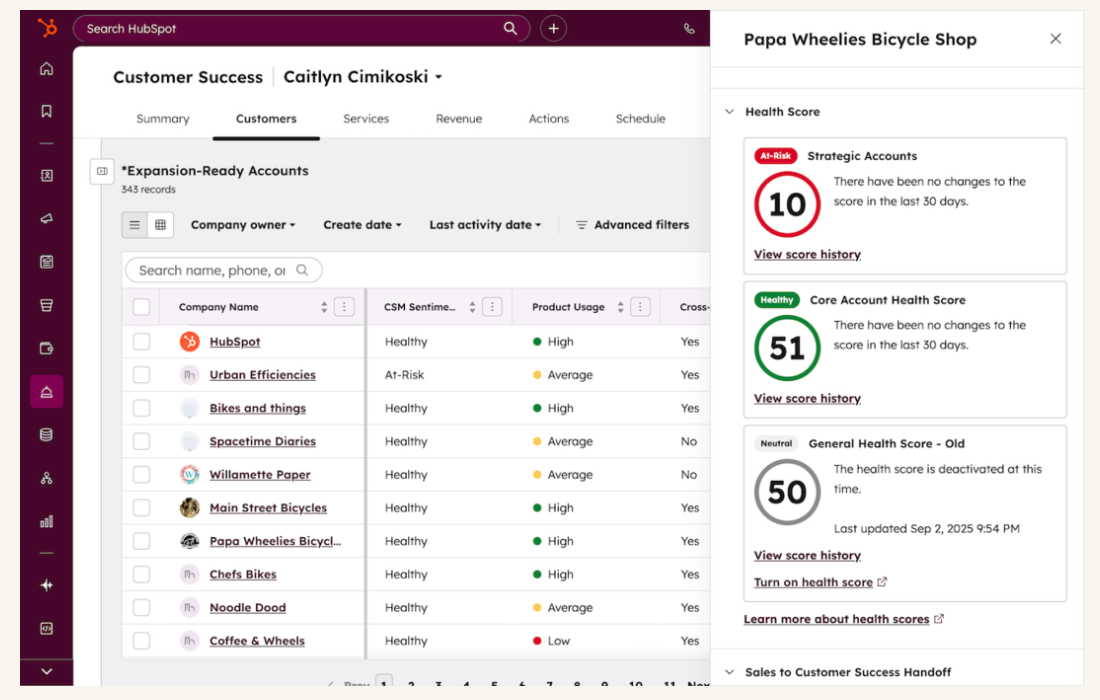
A CS admin builds a health score from event groups (1:1 calls, support tickets, CSM sentiment, NPS) and property groups, assigns points with caps and decay, and sets thresholds that write a health score and a status label such as Healthy, Neutral or At-risk onto the company or contact record.
CSMs work in the customer success workspace. The Customers tab lists owned accounts, the Revenue tab shows deals and subscriptions by stage, and the Actions tab holds tasks and health score alerts. Playbooks appear as guided cards on a record for onboarding, adoption check-ins, escalations and renewal calls.
The feature needs Service Hub Professional or Enterprise and a Service Seat. Professional includes basic renewal tracking, while Enterprise adds predictive churn analytics, custom health score algorithms and multiple health scores, per HubSpot's product page.
- Starting price
- From $90 per seat per month on Professional, plus a $1,500 one-time onboarding fee
- Needs
- Service Hub Professional or Enterprise
- Enterprise adds
- predictive churn analytics, custom algorithms, multiple health scores
- Playbooks
- up to 5,000 on Professional and Enterprise
Userpilot
Userpilot
A product-led tool that finds low-adoption users through event segments and reaches them with in-app flows, checklists and surveys.
A product-led tool for the users inside an account, not for the account record itself.
- you sell a SaaS product and want to reduce churn by guiding low-adoption users inside the product
- product and CS share ownership of onboarding and feature adoption and need retention analytics in one tool
- you need account health scores, renewal dates and a CSM task queue: Userpilot works on users inside the product, not on accounts
- your product has more than 2,000 monthly active users on a small budget: Starter is capped there and Growth starts at $849
- Users like
- self-serve onboarding flows without engineering and strong support
- Users dislike
- a steeper learning curve for new users
- Source: G2, 950 reviews
How it works in practice
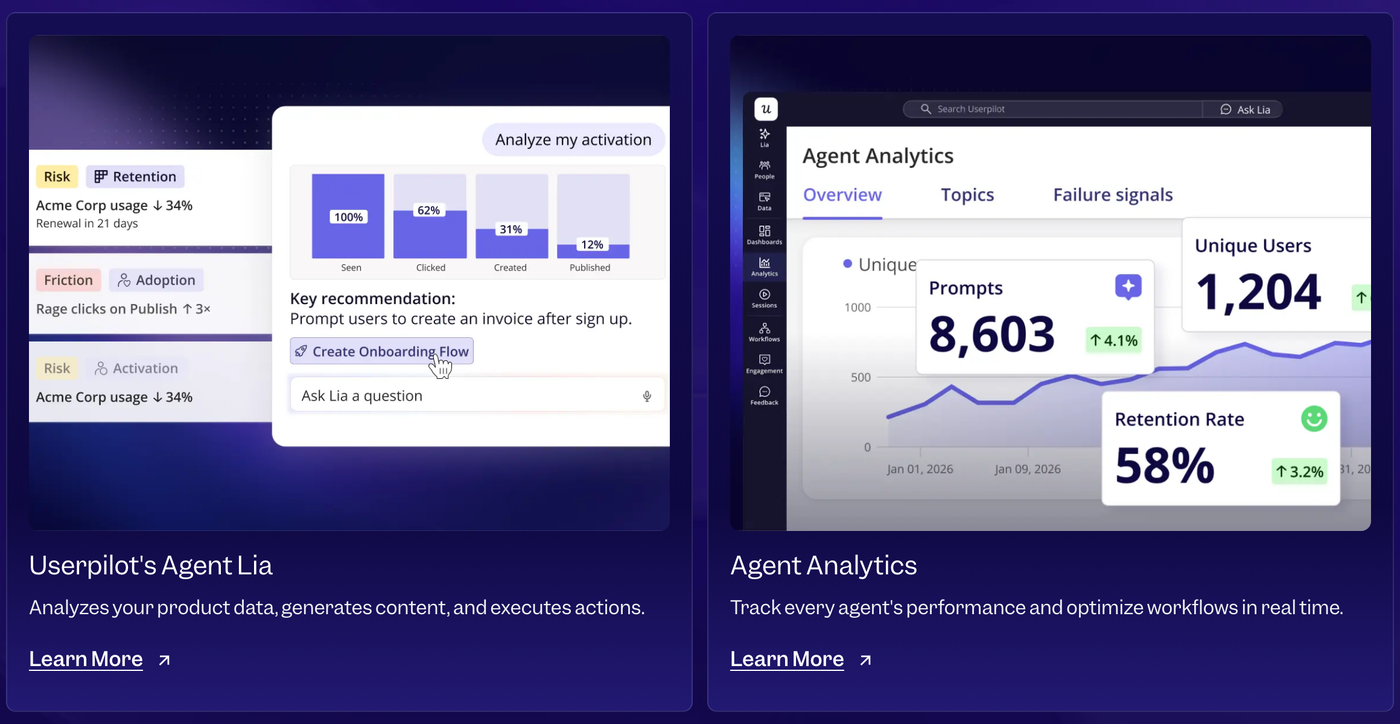
Product or CS teams track in-app events and company data, then build segments such as low feature usage or detractor NPS. A segment triggers a no-code in-app flow, banner, checklist or survey for those users, and Growth adds email workflows. NPS and survey answers become segment conditions, so a detractor gets a targeted follow-up, and responses can sync to a CRM.
Plan limits matter here. Starter caps at 2,000 monthly active users and 10 segments, retention reports and the Resource Center start on Growth, and the HubSpot and Salesforce integrations are paid add-ons.
Userpilot works on users while the platforms above work on accounts, so pair it with one of them if you need account health scores, renewal dates or a task queue. Our comparison of customer engagement software covers Userpilot next to Intercom, Pendo and Customer.io for in-app and lifecycle messaging.
- Starting price
- $299 per month (Starter, up to 2,000 MAU), Growth from $849 per month
- Starter limit
- 2,000 MAU, 10 segments
- Retention reports
- Growth plan and above
- CRM sync
- HubSpot and Salesforce are paid add-ons
How to choose customer retention software
Choose customer retention software by the data you already have, then by who will run the tool, then by what the vendor will show you before a sales call.
Data you need first
Of course, a health score is only as good as its inputs. Vendor demos start with features, but before you compare them, list where usage, support and billing data live today and which of them each tool can read. A tool that can't see product usage will score on tickets and meetings only. If your customers sit in HubSpot CRM, a native suite avoids an integration, but if usage lives in a warehouse, look at tools with warehouse connectors.
Integrations and setup time
Retention software only works with the data you connect to it. Plan to link your CRM, your support desk, billing and product usage before the scores mean anything. Vendors describe setup differently: Custify promotes a four-week guided onboarding, HubSpot charges a one-time onboarding fee on Professional and Enterprise, and G2 reviewers of Gainsight, Planhat and Vitally name setup effort as a common complaint. Ask each vendor which connectors are native, which need an add-on and who builds the first health score.
Who will run it
Rule-based platforms need someone to build and maintain scorecards, plays and automations. Admittedly, that effort pays off across a large book of accounts, but G2 reviewers of Gainsight, Planhat and Vitally name setup effort as a common complaint. Without a customer success operations owner, choose a tool with guided onboarding or a native suite and keep the first version of the health score small. If the gap is the onboarding project itself, see our guide to the best customer onboarding software.
What it costs
Customer retention software with a published price is rare, because only three of the eight tools in this guide show one: HubSpot, Userpilot and Odie's two new tiers. The other platforms are quote only, so budget time for sales calls, and ask for the plan limits in writing, although vendors may not volunteer them: users, customers per user, and which plan unlocks renewal forecasting or predictive scoring.
- You manage a large book and want rule-driven risk tasks and renewal forecastingGainsight Enterprise
- You want alerts, plays and renewal forecasts for a mid-market teamChurnZero or Vitally
- Your customer records already live in HubSpot CRMHubSpot Service Hub Professional
- You are a small SaaS team and want to be live within weeksCustify
- Retention is a product adoption problemUserpilot, plus a platform for account health
- You need to track what your team promised each customerA commitment ledger next to any of the above
The retention gap these tools don't track
Every tool above scores behavior: logins, tickets, survey answers, renewal dates. However, none of them records what your team promised. A CSM agrees on a call to deliver an integration review before the customer's security audit, the note stays in a call summary, and three months later a new owner takes over the account without knowing the promise exists. The health score looks fine, but the customer still remembers the promise.
That gap is narrow, and it's the one our own product, The Customer Success Manager, covers. It doesn't replace a customer success platform.
Whatever tool you pick, run a quick check on your current accounts:
- Can you list every open promise made to this customer in the last 90 days?
- Does each promise have one named owner and a due date?
- Is there a source note or recording that shows the customer heard it?
- Did someone other than the owner verify that it was delivered?
- Does the next account owner see these promises on handover?
FAQ
What is the best customer retention software?
There is no single winner, because the answer depends on your data and your team. If customers already live in HubSpot CRM, HubSpot Service Hub is the shortest path. If many CSMs need rule-driven risk tasks and renewal forecasts, look at Gainsight. Mid-market teams that want alerts and plays in one tool should compare ChurnZero and Vitally.
What is the best customer retention software for a small team?
HubSpot Service Hub works if you already run HubSpot CRM, Custify is built for small and mid-size SaaS teams and offers a guided four-week onboarding, and Userpilot suits a product-led company that wants to guide low-adoption users in the app. Small teams should start with a simple health score built on two or three signals.
Which retention tools connect to Salesforce or HubSpot CRM?
ChurnZero, Vitally, Planhat and Custify list both Salesforce and HubSpot among their integrations, and Totango lists them too. HubSpot Service Hub runs on HubSpot CRM natively. We couldn't confirm Gainsight's CRM connector on the vendor pages we read, so ask Gainsight which CRM sync your plan includes.
How much does customer retention software cost?
Most customer success platforms hide their prices. Among the eight tools here, only HubSpot Service Hub, Userpilot and Odie list starting prices, and they use different models: per seat for HubSpot, by monthly active user band for Userpilot and by portfolio size for Odie. Gainsight, ChurnZero, Vitally, Planhat, Custify and legacy Totango are quote only.
Which metrics should I track to measure retention?
Track logo retention (the share of customers who renew), gross revenue retention (recurring revenue kept from existing customers before expansion) and net revenue retention (the same including upgrades). Watch the leading signals that move first, such as login frequency, support ticket volume and champion changes.
How is customer retention software different from loyalty software?
Retention software for B2B teams finds account risk and manages renewals. Loyalty software rewards repeat purchases by consumers with points or perks. The two solve different problems, and this guide covers only the first.