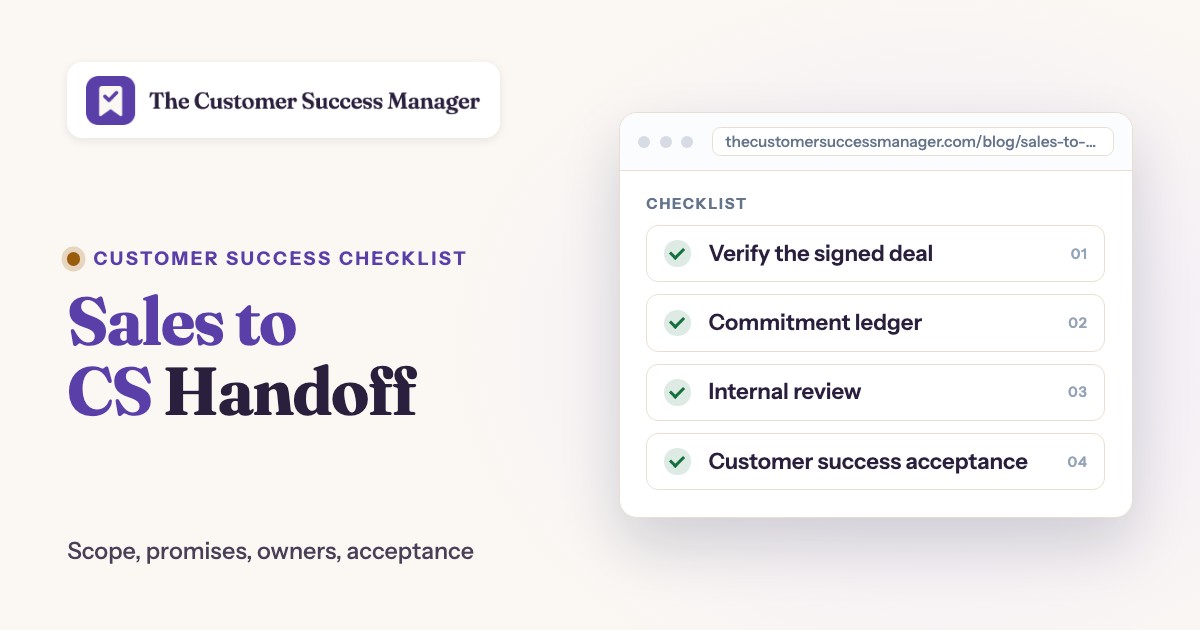
A sales to customer success handoff checklist transfers the deal's objectives, promises, stakeholders, and risks before onboarding. Use this practical template to reduce lost context and assign clear owners.
- Hand over goals, contract scope, stakeholders, commitments and risks, not just the account owner field.
- Keep a commitment ledger with an evidence link and an owner for every promise.
- The receiving CSM accepts, accepts with exceptions, or returns the handoff.
- Warm introduction first, onboarding tasks second, verification after kickoff.
What is a sales to customer success handoff?
A sales to customer success handoff transfers the buyer's objectives, commercial agreement, key relationships, outstanding commitments, and delivery constraints from the selling team to the team responsible for the customer relationship. It isn't simply changing an account owner in a CRM. The receiving manager should be able to explain what the customer expects, what remains uncertain, and who's responsible for each next action. The customer shouldn't have to repeat the entire sales discovery at kickoff. A complete record is particularly valuable when the seller changes roles or when onboarding takes several weeks.
Copyable sales to customer success handoff checklist
Use the checklist below in a CRM or shared account document. Mark each item complete only when supporting evidence is accessible. Sales owns the accuracy of the record, while the receiving customer success manager confirms readiness.
- Attach the executed agreement and amendments
- Confirm scope, start date, renewal terms and exclusions
- Record the customer's buying trigger in their own words
- Name the economic buyer, champion, administrator and skeptics
- Document desired outcomes, baseline and measurement owner
- List every promise made during sales conversations
- Distinguish approved commitments from open requests
- Record technical prerequisites and security dependencies
- Assign owners and deadlines to outstanding issues
- Hold an internal review and record acceptance
- Introduce the CSM and agree the first customer meeting
- Schedule a checkpoint to review unresolved promises
Step 1: Verify the signed deal
Start with the executed contract, not the amount or term displayed on the opportunity card. Confirm the legal customer, product scope, contracted services, quantities, service start date, and renewal provisions. Capture any special terms in a restricted location with appropriate access. A signature date may differ from the service start date, and a promotional concession may have its own expiration. Never assume either. When the CRM and contract disagree, ask Sales Operations or Legal to resolve the discrepancy. The receiving CSM needs the controlling document, not an unverified summary. Record links to evidence rather than copying sensitive contract terms into an open team chat.
Step 2: Capture the customer's reason for buying
The account executive should describe the operational problem that caused the buyer to act, who experiences that problem, and why the customer selected this solution now. Use discovery notes and the customer's actual language when available. Don't invent a quote or substitute the seller's interpretation for the customer's stated objective. For every intended outcome, document the starting position, the desired future state, how progress will be measured, and the customer contact who will validate it. If the baseline is unknown, label it as an item for kickoff. That's more useful than inventing a target or presenting a vague goal as measurable.
Step 3: Map stakeholders and approvals
Identify the economic buyer, executive sponsor, champion, technical administrator, day-to-day users, and any stakeholder who raised objections. Roles may overlap, but a single champion is rarely a complete stakeholder map. Record who can approve the implementation plan, who grants technical access, and who can resolve scheduling conflicts. Note preferred communication channels only if the customer has provided them. If a crucial decision-maker was absent from sales meetings, make the introduction a named task. This map helps the CSM avoid directing an important approval request to someone who can't authorize it.
Step 4: Create a commitment ledger
Review proposals, order forms, approved email threads, and meeting notes for commitments about training, features, integrations, discounts, timelines, and support. Give every commitment an evidence link, approval status, accountable owner, and next decision date. Separate contracted obligations from informal discussions and tentative roadmap ideas. An unapproved promise mustn't become a delivery guarantee merely because it appears in the handoff. If the promised work can't be confirmed, Sales and Customer Success should agree who will clarify the situation with the customer. An accurate unresolved item is better than a false green checkmark. Preserve the source message so future owners can distinguish what was said from what was assumed.
Step 5: Record technical dependencies
Document the systems involved, data sources, access requirements, security reviews, integration expectations, and implementation contacts. Mark each dependency as confirmed, pending, or not applicable. A mention of an integration in a sales call isn't evidence that it exists or is included in the agreement. Assign a technical owner to validate feasibility before offering a delivery date. Also record organizational constraints such as procurement approvals, change windows, and the customer's availability for testing. These dependencies may shape the rollout more than the software configuration itself. Keep the distinction between customer-owned and vendor-owned tasks explicit.
Step 6: Review the record internally
Hold a short internal review with the account executive and receiving CSM. Include a solutions engineer or implementation lead when the deal includes technical complexity. The seller should explain the business reason for the purchase, the CSM should restate the intended outcome, and both should inspect open commitments and risks. Use the meeting to resolve contradictions rather than reading the checklist aloud. Record unanswered questions and assign a person and date to each. A meeting without a decision or updated record doesn't complete the handoff. For a straightforward standardized purchase, an asynchronous review may be sufficient if the same acceptance requirements are met.

Step 7: Require customer success acceptance
Define three outcomes: accepted, accepted with documented exceptions, and returned for completion. The receiving team should accept only when it can identify the buyer's goal, contractual scope, key contacts, and next actions. Exceptions must have named owners and an explanation of why they don't block onboarding. A missing secondary contact might be manageable. An unapproved promise that defines the customer's purchase may require escalation before kickoff. Record the acceptance decision in the account system. This creates a clear point of ownership transfer without implying that every open implementation task has already been completed.
Step 8: Send a warm customer introduction
The account executive should introduce the CSM, acknowledge the customer's confirmed goal, explain who owns the next phase, and name the next meeting or action. A useful message reads: 'Hi [Name], I'd like to introduce [CSM], who'll coordinate the next phase of your onboarding. We've reviewed the agreed scope and the open items from our conversations. Our next step is [action] on [date]. I'll remain available for questions about our sales discussions.' Avoid saying that every technical detail is finalized when approvals remain open. A transparent introduction sets more reliable expectations than a generic congratulations message.
Step 9: Convert the handoff into onboarding tasks
The handoff describes what was agreed; onboarding organizes how to deliver it. Turn each confirmed objective into milestones, owners, deadlines, and evidence of completion. Turn each open promise into a tracked decision or task. Carry forward known risks instead of creating a clean plan that ignores them. At kickoff, confirm what has changed since signing and validate the stakeholder map. Don't make the customer repeat discovery already documented. The implementation sequence should fit the actual purchased scope, not a generic timeline presented as a guarantee. A good plan connects each task to the outcome the buyer wants.
Step 10: Verify the transition after kickoff
At the first meaningful progress checkpoint, ask whether the customer has encountered any difference between the sales discussion and the delivery plan. Compare the commitment ledger with actual decisions and completed work. Escalate mismatches promptly. Internally, track how often required fields were missing, how long acceptance took, and how many pre-sale commitments surfaced after kickoff. These are process indicators, not proof of improved retention. Review patterns and update the checklist when the same issue repeats. The goal is a handoff process that prevents surprises, not a document that looks complete while critical questions remain unanswered.
Who owns what during the handoff
Ownership is the part of a handoff that most often stays implicit. Settle it before the internal review so nobody discovers a gap at kickoff.
| Task | Owner before acceptance | Owner after acceptance |
|---|---|---|
| Accuracy of contract and scope summary | Account executive | Customer success manager |
| Commitment ledger | Account executive | Customer success manager |
| Technical feasibility checks | Solutions engineer | Implementation lead |
| Customer introduction | Account executive | Customer success manager |
| Open pre-sale questions | Account executive | Named owner per item |
How the handoff changes with deal complexity
A single-seat, self-serve upgrade doesn't need the same process as a multi-team rollout with security review. Scale the handoff to the risk. For a standardized purchase, a short asynchronous record with acceptance is enough: goal, scope, contacts and next action. For a custom scope, a regulated buyer or several stakeholders, add the live review, the full commitment ledger and a documented technical dependency list. The acceptance rule stays the same in both cases. The receiving CSM must be able to explain the customer's goal and scope from the record alone. If they can't, the deal isn't ready to hand over, however small it is.
Teams that already use a shared account brief can reuse it here. See our customer handoff template for an account brief layout and the customer success onboarding checklist for what happens once the handoff is accepted.
Worked example: a fictional account
Imagine a regional service company buying a scheduling system. Its operations director wants to reduce manual schedule reconciliation before a seasonal hiring period. The sales representative has documented the problem but has no baseline for time spent. The economic buyer's the operations vice president, the champion's a regional manager, and IT owns identity access. Sales discussed a possible payroll integration, but technical feasibility isn't confirmed. Administrator training appears in the signed scope. The handoff correctly treats training as contracted, the integration as pending technical review, and the baseline as a kickoff discovery task. The CSM accepts with an explicit exception and doesn't promise the integration before the review. The account is made up, but the ownership logic carries over to real deals.
How should you measure handoff quality?
Measure completion at first submission, time from signed agreement to acceptance, unresolved exceptions, and customer-reported surprises. Define the denominator and reporting period for each measure. For example, completeness can mean handoffs accepted without missing required fields divided by all handoffs reviewed during the period. Segment by account complexity so simple and implementation-heavy deals aren't treated as equivalent. Don't expect an improved checklist alone to raise renewal rates. The measurements show whether information moves reliably between teams. Customer retention depends on many additional factors.
Common handoff mistakes
The first mistake is forwarding a CRM link without summarizing the customer's objectives. The second is documenting only contractual obligations while losing informal promises that still shape customer expectations. The third is treating an unverified integration or roadmap discussion as a guaranteed feature. Another mistake is introducing the CSM before clarifying who owns open issues. Finally, teams often confuse handoff completion with onboarding completion. The receiving team can accept responsibility while implementation work remains outstanding, provided those tasks are explicit. Avoid these errors by requiring evidence, ownership, and acceptance rather than simply more form fields.
Final acceptance test
Ask the receiving CSM to explain the customer's goal, identify the decision-makers, locate the executed scope, list outstanding promises, and name the next customer-facing action. If they can do this using documented evidence, the transfer is ready to support onboarding. If they can't, return the handoff for completion with specific missing items and owners. The checklist is useful only when it makes the customer's next experience more consistent with the commitments that led them to buy.
FAQ
When should the handoff begin?
Capture context during the later sales process and confirm it when the agreement is executed. Complete the internal review before kickoff.
Does every deal need a live meeting?
No. A simple deal may use asynchronous acceptance; complex scope and unresolved commitments usually benefit from discussion.
What's the difference between handoff and onboarding?
The handoff transfers context and ownership. Onboarding delivers the agreed services and verifies progress toward the customer's goals.
What if Sales promised an unavailable feature?
Preserve the evidence, identify the authorized decision-maker, and correct expectations with the customer. Don't invent a delivery date.
Where should the checklist live?
Keep it alongside the account record, with links to authoritative documents and appropriate access controls.
Who should own the handoff checklist?
The account executive owns the accuracy of the record and the receiving customer success manager owns the acceptance decision. A revenue operations or CS operations lead usually maintains the template itself.