ChurnZero review verdict: ChurnZero is a customer success platform that combines hand-built health scores, automated plays and journeys, in-app messaging, renewal forecasting and a catalog of AI agents in one product. It fits teams that want CSMs to build and inspect the health model themselves and that need to reach many customers without writing a message by hand each time. It's a weaker fit if you need a trained churn model with a probability output, or a price you can read before you talk to sales.
Its 4.7 out of 5 rating on G2 from 1,638 reviews is strong for a platform this broad, and reviewers praise ease of use, automation and support. Reviewers also describe a learning curve and complexity, which fits a product with this much capability and this much configuration behind it.
- Best fit: a CS team that wants to build its own health score, trigger plays and journeys from it, and message customers inside the product.
- Strength: ChurnScores are rules a CSM can read, calculate against real accounts and change themselves.
- Watch-out: scores, plays and segments need an owner; G2 reviewers flag a learning curve and complexity.
- AI: Harbinger flags relationship risk with a type, urgency and impact. It's a signal agent, not a published churn probability model.
- Pricing: quote only. Professional and Enterprise editions; the AI bundle is sold separately.
- G2 rating from 1,638 reviews
- 4.7 / 5
- average implementation time reported on G2
- 3 months
- points every ChurnScore must add up to
- 100
- CRM sync interval for the Renewal and Forecast Hub
- 15 min
What is ChurnZero?
ChurnZero is customer success software that unifies account data, scores customer health, automates customer outreach and tracks renewals for subscription businesses. The vendor describes it as an AI platform for customer growth, and its feature catalog groups the product into four jobs: unify account data, automate workflows, engage customers in and outside the product, and analyze what is working.
In practice that means one system where a CSM opens an account, sees a color-coded health score, sees which play or journey the account is in, and sees the renewal in the forecast. The vendor lists customer profiles, ChurnScores, segments, a Command Center, a REST API and more than 70 native integrations under the unify job. It lists customer playbooks, journeys, real-time alerts, Success Plans and a library of prebuilt templates called Launchpad under automate. Under engage it lists in-app communications, WalkThroughs, Success Centers, surveys, customer communities and learning management. Under analyze it lists Account Insights reporting, Success Insights and the Renewal and Forecast Hub.
Here's a fair way to read that list: ChurnZero's built for the CS motion that runs on signals and segments, not only on one-to-one account management. If every one of your customers has a named CSM who knows the account by heart, you'll use a fraction of it.
Who should consider ChurnZero?
ChurnZero makes the most sense when three things are true. You've got enough customers that a CSM can't watch each one. You can send usage, support and survey data into a central place. And someone will own the configuration after the vendor's onboarding ends.
The product pages point to a few team shapes that benefit:
- Digital or tech-touch CS programs. In-app announcements, surveys, WalkThroughs and Success Centers let a small team reach a large customer base inside the product. The vendor claims 10x coverage with the same quality for tech-touch accounts. The page gives no method for that figure, so treat it as a hypothesis to test in a pilot, not a result.
- Teams that want to own the health model. ChurnScores are built by the CSM from named factors and weights, which suits a team that wants to explain every score to a skeptical sales leader.
- Renewal-driven organizations. The Renewal and Forecast Hub puts renewals, expansions, contractions, gross revenue retention and net revenue retention in one workbook next to the health score.
It's a weaker fit if your customer data lives in spreadsheets, if nobody owns CS operations, or if your accounts number in the dozens and a CRM view plus a weekly review would do the job. If you're still deciding whether you need a platform at all, our customer success software guide walks through the category.
How ChurnScores work
ChurnScore is ChurnZero's name for a customer health score, and it's the center of the product. You'll build it yourself. ChurnZero's support documentation describes a Standard ChurnScore, built from individual factors, and a Composite ChurnScore, which uses other ChurnScores as its inputs.
Building the score
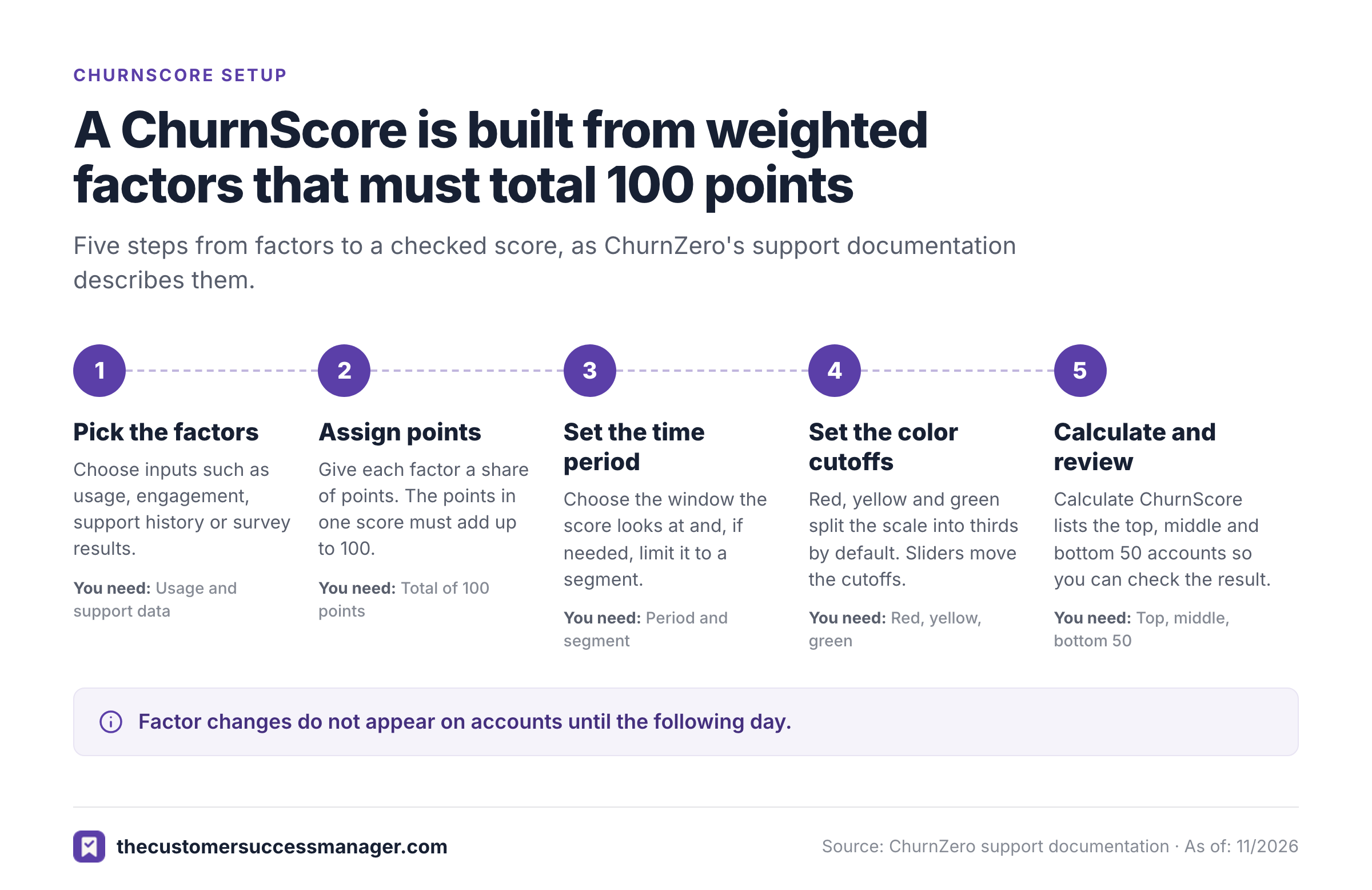
Each factor gets a share of points, and the points in a score must add up to 100. You choose a time period for the score to look at, and you can limit a score to specific segments. The scale is divided into thirds by default: red for poor, yellow for okay and green for good. Sliders let you move the cutoffs. A worked example in the documentation gives full points for an account that creates 10 or more blog posts in the last 30 days and zero points for an account that creates none.
The factor families the vendor names are account attributes, engagement and activities, product usage for specific features or pages, journey progression, usage metrics such as license utilization and active contacts, risk factors, support history (ticket volume, duration, SLA issues, case severity), loyalty measures such as tenure and NPS, CSAT or CES surveys, and general satisfaction. You can build separate scores for SMB, mid-market and enterprise customers, by lifecycle stage, by industry and by region.
Checking the score before you trust it
The most useful detail in the documentation is the Calculate ChurnScore button. It opens a list of your top, middle and bottom 50 accounts, ordered by score, so you can check whether the green accounts look healthy and the red ones look like trouble. Do this before you attach a play to the score, because it's far cheaper to find a bad weight before a play acts on it. Factor changes don't show up on accounts until the following day, so plan your tuning in daily cycles rather than live edits, since you can't see a change the moment you make it.
What a ChurnScore won't do
ChurnZero doesn't publish a churn probability, a revenue-at-risk model or a validation method for its scores. A ChurnScore is a weighted set of rules that you write, and it's only as good as those rules. That's a strength when you need transparency and a limit when you expect a model to discover patterns you didn't think of. Success Plans can also feed the score: you can weight a ChurnScore by the percentage of plans and goals achieved and by the number of plans and goals created. If you want a model-first approach to risk, compare the options in our churn prediction software guide.
Plays, journeys and Success Plans
Scores only matter if something happens when they change, and ChurnZero's answer is an automation layer built around customer playbooks, which it calls plays, and journeys.
Plays are described as automated workflows that trigger, schedule and target customer engagements, create tasks and send information to integrated systems. The vendor describes three stages for building one: segment the customers, decide the steps, and build one play with multiple steps. Conditional logic moves an account through the steps based on triggers. CSMs can approve accounts into a play or remove them based on engagement and other factors, which keeps a human in the loop for sensitive accounts. Launchpad provides prebuilt plays for each lifecycle stage so the first version doesn't start from a blank page.
Example uses on the vendor's page include following up on survey responses, starting upsells, announcing new user logins, telling customers about license utilization, sending renewal reminders and kicking off renewal processes. Real-time alerts notify the team when a score or an account event changes, although a flood of alerts is its own risk, so tune them early.
Success Plans are shareable, real-time documents that set a customer's goals and break them into actions and tasks, each with an assignee. The vendor says there's no limit on the number of Success Plans per account, and that Dynamic Slides pull plan goals and progress into quarterly business review decks. If you'd like to see what a good plan contains before you configure one, use our customer success plan template.
Ask the vendor to show one concrete chain in your demo, and don't let them skip a step: a license utilization factor drops, the ChurnScore turns yellow, the CSM gets an alert, a play starts, a suppression rule stops an upbeat message because a support escalation is open, and a task lands with the right owner. If the chain works with your sample data, the platform's doing its job. If any link needs custom work, price it.
In-app engagement and customer communication
ChurnZero reaches customers inside the product, although email remains part of the mix. The vendor's in-app communications page lists four message types, and each one does a different job.
- In-app announcements appear to users when they log in.
- Surveys appear in the product and can also go out by email at the same time, in NPS, CES and CSAT formats.
- Success Centers give customers one hub for resources, documents, videos and announcements.
- WalkThroughs show announcements, training and videos in the product while users work.
Segmentation decides who sees what and when, and the platform tracks views and clicks so a team can refine its approach. Customer journey progress can be displayed to users as well.
The vendor's public pages don't describe the technical requirements for in-app messaging, such as any code that must be installed in your product. Ask for them early, since they're easy to miss in a demo. In-product messaging may depend on engineering time, and if it does, that time belongs in your plan.
Renewal and Forecast Hub
The Renewal and Forecast Hub, announced in April 2023, tracks up-for-renewal accounts, renewals, expansions, contractions, upsells, downsells, churn, gross revenue retention and net revenue retention in dollars. The vendor says it syncs with your CRM every 15 minutes and uses ChurnZero health scores, which it presents as the difference from a CRM-only forecast.
Support documentation says reports can draw on ChurnZero data, CRM data or both. Every user can view, use and export active renewal reports, but only users with the Renewal Hub permission can create, edit or delete one. Each report has a Workbook tab where leaders can review open, forecast-to-close, overdue and high-risk opportunities, customize forecast categories, add ChurnScores to a report and compare forecasts against results for net and gross retention.
The vendor makes no accuracy claim for its forecasts, so the numbers are only as good as your data. Before you rely on it, agree on three definitions: which contract date governs a renewal, how parent and child accounts roll up, and which system owns recurring revenue.
AI agents and Harbinger
ChurnZero's AI catalog is long. The vendor lists agents for stakeholder mapping (Archetype, Pulse), tone changes (Vibes), advocate and intent detection (Herald, Beacon), feedback themes (Echo), proof of value (Spotlight), Success Plan drafting (Consult, Compass), handoffs between sales, implementation and CS (Baton, Liftoff, Transfer), drafting (Scribe, Crux, Verse, Recap) and churn notes with a confidence score (Retrospective). Two items are marked coming soon on the vendor's page: AI CSM, which would watch, sort and act across accounts, and Kit, a builder for custom agents. ChurnZero Connect brings live ChurnZero data into other AI tools through MCP with permission-based guardrails.
The agent most relevant to this review is Harbinger, the relationship-risk agent. It analyzes customer engagements, account context and prior signals. The vendor says it looks for reduced engagement, shifts in tone, missed moments and unanswered outreach, and that each risk signal carries a type, urgency and impact together with supporting context and recommended next steps. For high-urgency signals the page suggests acting within 48 hours, for example with a fast check-in, a service recovery step or an executive touchpoint.
Here are two cautions. First, the vendor doesn't publish accuracy rates for Harbinger, so test it on accounts whose outcome you already know. Second, the agents are sold separately. ChurnZero launched Agentic Essentials in June 2026 as a single annual subscription with a flat fee and a set allotment of credits, available on the Professional and Enterprise editions. The public pages don't list what the bundle costs. Agent features you see in a demo may not be in your base quote, so get each one marked as included, optional or unavailable.
Integrations and data setup
ChurnZero lists 11 CRMs on its integrations page: Salesforce, HubSpot, NetSuite, Close, Copper, Dynamics 365 CRM, Freshsales, Pipedrive, Spiro, Zendesk Sell and Zoho CRM. It lists 12 support tools, including Zendesk, Salesforce Service Cloud, HubSpot Service Hub, Freshdesk, Help Scout, Intercom, Jira Service Management and ServiceNow. For data warehouses it lists Amazon S3, Snowflake and Google BigQuery, and under usage it lists Intercom, Mixpanel, Pendo and Segment. A REST API covers anything else.
A connector list tells you what can connect but not how clean the result will be. The work that decides whether ChurnZero succeeds is mapping: which customer identifier is the master, how usage events are named, how contract dates arrive, and what happens when two systems disagree. G2 reviewers report an average implementation time of three months, and that's a better planning number than any demo.
What users say: G2 themes
On G2, ChurnZero holds 4.7 out of 5 across 1,638 reviews. Reviewers most often praise ease of use, automation and customer support. The most common complaints are a learning curve, complexity and a product that isn't always intuitive.
Those two lists aren't a contradiction, because they describe the same trade-off. A product can be easy to use for the people who configure it and still hard for a new CSM to learn when it's got dozens of modules. Frankly, the complaint is a staffing warning, so budget for admin training, a named owner and a plan for new-hire onboarding. Review sites also reflect who chooses to write a review, so they're best used to form questions for the vendor, not to settle the decision.
Limitations and risks
No published churn model. ChurnScores are rules you author, and Harbinger is a signal agent. Neither is documented as a trained probability model. If you need a modeled churn probability, ask for validation evidence or look elsewhere, but don't assume one exists.
Configuration is an ongoing job. Scores, segments, plays and reports drift as your product, pricing and customer base change. Name an administrator and a review cadence before you sign, because that work doesn't do itself after launch. A rule that worked for last year's customers can quietly mislead this year's, although the dashboard will still look fine.
Edition and package clarity. ChurnZero sells Professional and Enterprise editions, with agents in a separate bundle. The public pages don't list what each edition includes, so you can't compare editions without asking. Get a written feature entitlement list.
Quote-only pricing. The vendor publishes no price, whereas some competitors show plan tables. Our ChurnZero pricing guide covers quote variables, the first-year budget and the renewal terms in the published subscription terms.
Vendor claims. Figures such as 10x coverage come from the vendor's marketing. Don't carry them into a business case without your own pilot data.
ChurnZero vs alternatives
If you're comparing ChurnZero with the other large platform in the category, the main difference is the operating model. Our Gainsight vs ChurnZero comparison sets the two side by side, and our Gainsight review covers the other product on its own terms. For a wider shortlist, read our ChurnZero alternatives guide.
Give every vendor the same scripted test, and don't let any of them choose their own data. Use one messy account, one renewal in 60 days, one open escalation and one customer who shouldn't receive a campaign. Score what you see, not what the slide says, and keep notes while you're watching. Keep functional scoring and price scoring separate, otherwise a better demo can hide a worse contract.
How to test ChurnZero in 30 days
A pilot shouldn't try to prove everything. A good pilot shows whether ChurnZero reduces the time CSMs spend finding context and gets the right action to the right customer sooner. Here's a plan you can use.
Write the problem and the baseline
State the job in one sentence, such as 'CSMs lose time gathering context and leaders can't see which onboarding accounts need help'. Measure the current prep time on five accounts.
Inventory and map your data
List each source, its owner and its refresh rate: CRM, support, product usage, surveys, billing. Decide which ID is the master.
Build one ChurnScore and calculate it
Pick five to eight factors, set points that total 100, run Calculate ChurnScore and review the top, middle and bottom 50 accounts with the people who know them.
Attach one play and one suppression rule
Start a play from a score change, and prove that an account with an open escalation doesn't get an adoption message.
Test the renewal view
Rebuild next quarter's renewal list in the Renewal and Forecast Hub and reconcile it with Finance's contract dates.
Decide with written terms
Compare the pilot against the baseline, then compare the written proposal with the evidence: included editions, agents, services and renewal terms.
Is ChurnZero worth it?
ChurnZero's worth a serious look when your team needs a transparent health score, automated outreach in and outside the product, and a renewal view tied to health, and when you can staff the administration. It's a better answer to 'how do we cover hundreds of customers consistently' than to 'how do we predict churn with a model', and that's an honest distinction to make with your own stakeholders.
Our verdict is conditional: choose ChurnZero when rule-based health scoring, plays, in-app engagement and renewal forecasting match how your team works and you have an owner for the configuration; skip it when you need a trained churn model, public pricing or a lightweight tool for a handful of accounts. The 4.7 G2 rating shows satisfied users, while the learning-curve complaints show what you'll need to budget for.
If your gap is narrower, such as keeping track of what your team promised each customer, a full platform may be the wrong tool, and you'd be paying for modules you won't use.
ChurnZero review FAQ
Is ChurnZero good for customer success teams?
ChurnZero suits CS teams that want to build their own health score, automate plays and journeys, message customers inside the product and forecast renewals. It rates 4.7 out of 5 on G2 from 1,638 reviews, and reviewers also mention a learning curve and complexity.
How does ChurnZero calculate health scores?
A CSM builds each ChurnScore from factors such as usage, engagement, support history and surveys. Every factor gets points, the points must total 100, and the scale is red, yellow and green in thirds by default. ChurnZero doesn't publish a churn probability model.
How much does ChurnZero cost?
ChurnZero doesn't publish a price. It sells Professional and Enterprise editions on a quote basis, and the Agentic Essentials AI bundle is a separate annual subscription. Request a written proposal that lists included editions, agents, services and renewal terms.
What is ChurnZero Harbinger?
Harbinger is ChurnZero's relationship-risk AI agent. It reads engagements, account context and prior signals and produces risk signals with a type, urgency and impact plus suggested next steps. The vendor publishes no accuracy figures for it.
How long does ChurnZero take to implement?
G2 reports an average implementation time of three months. Your timeline depends on how clean your CRM, usage and support data are and on who owns the configuration.
Which tools does ChurnZero integrate with?
ChurnZero lists 11 CRMs including Salesforce and HubSpot, 12 support tools including Zendesk and Intercom, Amazon S3, Snowflake, Google BigQuery, and usage sources such as Mixpanel, Pendo and Segment, plus a REST API.