The best net promoter score software depends on who has to act on a low score. CustomerGauge and ChurnZero score whole accounts, Retently gives you a published B2B price and a schedule you control, AskNicely turns a detractor answer into an assigned case and Zonka Feedback lists a response inbox with case management, and Refiner, Survicate and SurveySparrow are the cheaper way to ask the 0 to 10 question inside a product or an email. This guide compares eight tools for customer success teams on how the survey runs, whether the tool scores an account or only a contact, where a 0 to 6 answer goes, what each plan costs and who should skip it.
It's written for teams that sell software or services to business customers, where one account has several people who could answer and a renewal date that makes a detractor expensive. Delighted, a name on many older lists, isn't reviewed because Qualtrics now says on its Delighted page that the product is no longer available. Our guide to the best customer feedback software covers the wider survey category, and the best customer success software guide covers the platforms that score account health.
- tools compared
- 8
- document an account-level score
- 3
- G2 rating range
- 4.4 to 4.7
Best NPS software at a glance
 Best for account-based B2B NPSCustomerGaugeRolls feedback from several stakeholders into one account score next to revenue and renewal date. Starts at $24K, quote only.
 Best for a published B2B priceRetentlyEmail, in-app and link surveys with a default 30 day throttle and Slack alerts. B2B plans are $100 and $299 a month.
 Best if NPS should feed health scoresChurnZeroEvery response attaches to the contact and the account and updates an Account NPS metric. No public price.
 Best for assigned detractor casesAskNicelyA score of 6 or less opens a case with an owner and an SLA on Grow and Transform. Quote based.
 Best for many channelsZonka FeedbackNPS by email, SMS, WhatsApp and in-app with a response inbox and case management. Quote based, G2 lists $99 a month.
 Best for in-product NPSRefinerTriggers on page visits and tracked events with a per-user gap between surveys. $149 a month at 5,000 monthly users.
 Best for a HubSpot stack on a budgetSurvicateWrites answers to HubSpot contact properties and alerts Slack on low scores. From $114 a month billed annually.
 Best for a free startSurveySparrowA free plan and throttling at account and survey level. Workflows start at the Business plan.
 Our product · for the promise made after a detractor callThe Customer Success ManagerNot an NPS tool. It records what your team promised the customer, with owner and evidence.
| Tool | NPS type | Where a low score goes | Starting price | Rating |
|---|---|---|---|---|
| CustomerGauge | Account-based B2B NPS and customer experience platform | The vendor says detractor responses are assigned to the account's CSM with a deadline; it lists Salesforce, Dynamics 365 and Slack integrations. | Starting at $24K, custom quote; the page states no period or currency | 4.6 (50) |
| Retently | Standalone NPS and CX survey software | Low scores trigger Email, Slack or Teams alerts and autoreplies; listed integrations include Salesforce (Enterprise), HubSpot, Pipedrive and Intercom. | B2B plans from $100 per month (Basic) and $299 per month (Pro), Enterprise on quote | 4.7 (31) |
| ChurnZero | Customer success platform with built-in NPS surveys | Survey segments feed ChurnScores, alerts and plays, so a Detractor reply can start a CSM play inside the same platform. | Custom quote, no public price | 4.7 (1,630) |
| AskNicely | Customer experience / NPS platform | Detractor responses open cases with owners and SLAs on Grow and Transform, plus Slack and Teams alerts from Grow, helpdesk tickets and CRM records. | Not published. Quote based from 500 responses per year, annual contract, no free trial. | 4.7 (1,051) |
| Zonka Feedback | Customer feedback and CX platform | Per its G2 listing: alerts by email, SMS, WhatsApp, Slack or Teams, a response inbox with case management, and workflows to CRM and helpdesk tools. | Custom quote; G2 lists from $99 per month for Customer Feedback | 4.7 (85) |
| Refiner | In-app survey software | Responses can post to Slack, Teams or email and sync to Salesforce, HubSpot or product analytics tools via triggers. | Essentials $149 per month and Growth $279 per month at 5,000 MAU; Enterprise custom. 30 day trial. | 4.6 (26) |
| Survicate | Customer feedback survey tool | Slack and email alerts on low scores; answers sync to the CRM | Growth from $114 per month billed annually (250 responses a month), Pro from $349, Enterprise from $569; 10-day free trial | 4.6 (215) |
| SurveySparrow | Survey and CX platform | Threshold or relative NPS alerts to email, Slack or Teams channels, automatic tickets with routing rules, and workflows and webhooks on Business and above. | Free plan; paid plans Basic, Starter, Business, Enterprise (G2 lists $19, $39, $79, billing period not shown) | 4.4 (2,065) |
| The Customer Success Manager Our product | Customer commitment tracking | Not an NPS tool: records the promises your team makes to a customer, with owner and evidence | From $49/month per workspace | No reviews yet |
What is net promoter score software?
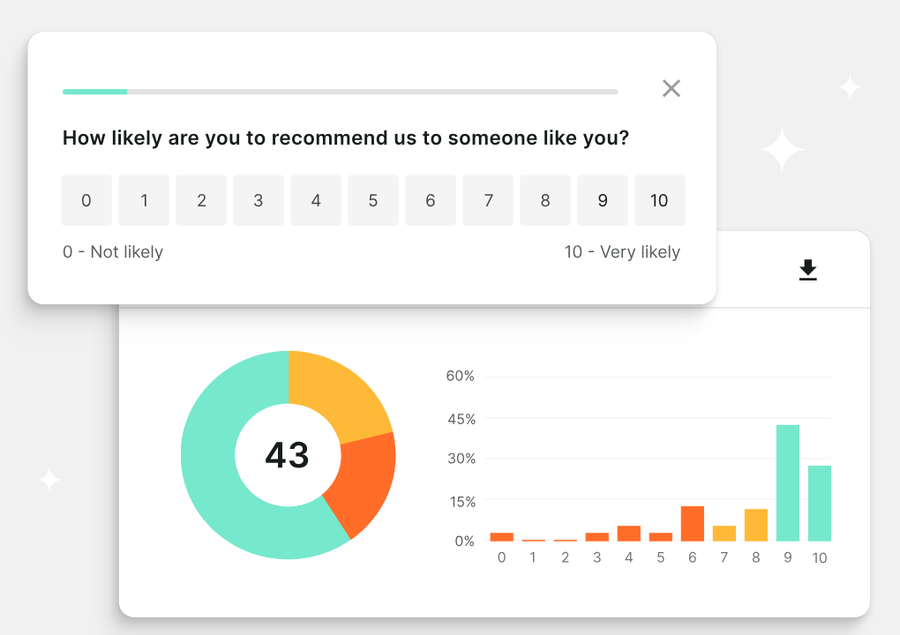
Net promoter score software sends the question "how likely are you to recommend us?" on a scale of 0 to 10, sorts the answers into promoters (9 to 10), passives (7 to 8) and detractors (0 to 6), and reports the share of promoters minus the share of detractors as a score between -100 and +100. For a customer success team the useful part is what happens next: who sees a low score, how soon, and whether it counts against the contact who answered or the account that pays.
Most tools add a follow-up question ("what is the main reason for your score?"), a way to repeat the survey on a schedule without nagging the same person, charts of the score over time, and links to the CRM, Slack or help desk where the follow-up happens.
How is NPS calculated?
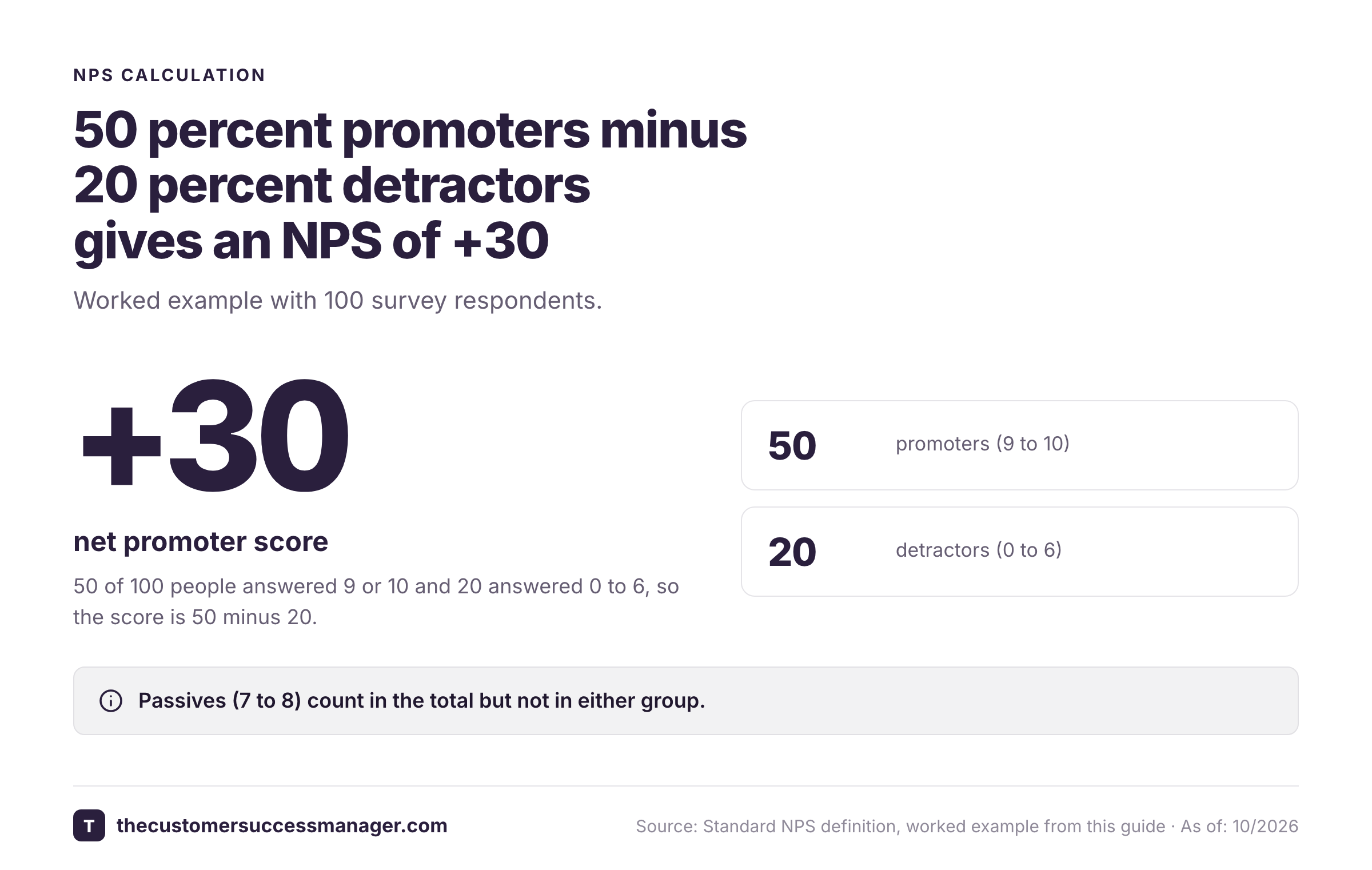
Take the percentage of respondents who answered 9 or 10, subtract the percentage who answered 0 to 6. If 50 of 100 people are promoters and 20 are detractors, the score is +30. Passives count in the total but not in either group. A score above 0 means promoters outnumber detractors, and the trend over several rounds tells you more than one number.
Four kinds of NPS software
The eight tools fall into four groups. The group matters more than the feature list: it decides who owns the survey and where the answer lands, not how many question types the builder offers.
| NPS type | How scores are collected | Tools |
|---|---|---|
| Account-based B2B NPS | Surveys go to several people per customer; CustomerGauge rolls them up to the account and Retently exports account-level scores | CustomerGauge, Retently |
| NPS inside a customer success platform | The survey is one module of the platform that already holds account data | ChurnZero |
| Closed-loop CX platforms | Surveys across many channels, with cases and workflows for low scores | AskNicely, Zonka Feedback |
| In-product and survey suites | A survey tool with triggers and alerts, usually priced by responses or monthly users | Refiner, Survicate, SurveySparrow |
Account-based B2B NPS tools
Account-based B2B NPS tools treat the score as a B2B metric. CustomerGauge is built around the account. Retently is a dedicated NPS tool with a separate B2B plan track and exportable account-level scores on its middle plan.
CustomerGauge
Account-level NPS tied to revenue and renewal date.
Fits enterprise B2B teams with several stakeholders per account who want NPS next to revenue, lifecycle stage and renewal date.
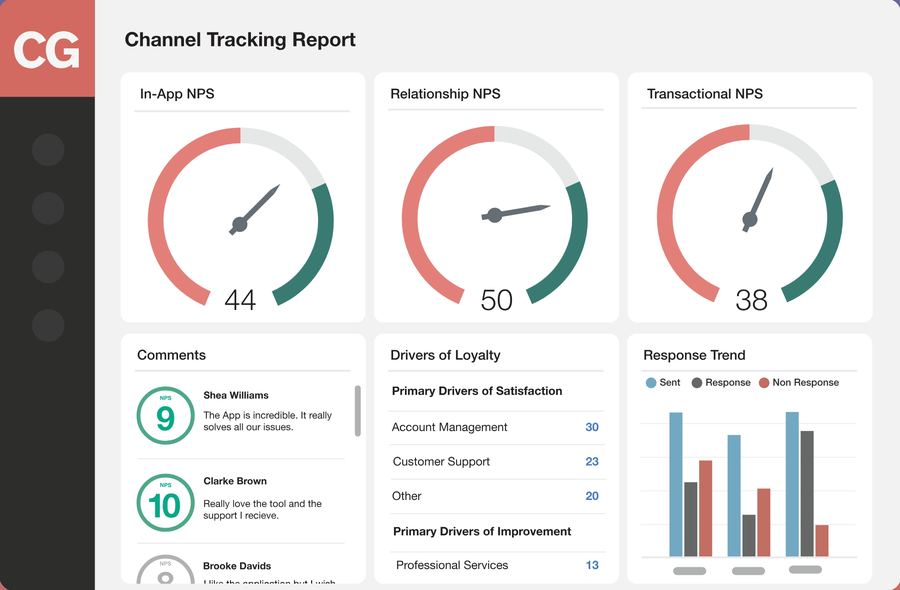
CustomerGauge scores the account, not the individual contact. Its Account Hierarchy rolls feedback from several stakeholders into one account-level NPS, and a single dashboard shows that score beside revenue, lifecycle stage, recent feedback, open cases and the renewal date. Accounts are ranked by revenue and NPS together and classed as safe, at risk or ready to expand. Surveys reach people as pop-ups inside software through Pendo and MadCap Flare, as end-of-call surveys through Genesys, after tickets through ServiceNow, or by survey link. The vendor states that every detractor response is assigned to the right customer success manager with a deadline and account context. It breaks on cost and access: there is no free trial, a pilot is paid, and we found no public help center to check how the setup works.
- You run enterprise B2B accounts with many stakeholders and want NPS tied to revenue and renewal date.
- You need Salesforce or Dynamics sync, ServiceNow or Genesys triggers, and assigned follow-up on every Detractor.
- Your budget is below the $24K starting price or you want a self-serve trial.
- You want flexible metrics beyond NPS or highly custom reports without vendor help.
- Users like
- Clear NPS dashboards and helpful support team
- Users dislike
- Report customization and advanced setup need help
- Source: G2, 50 reviews
Price, pilot and integrations
The pricing page says plans start at $24K and describes one flat platform fee with unlimited surveys, users and integrations, but it states no billing period or currency, so we read it as an annual USD figure. Pricing depends on the size of the account base and the modules you activate. Pilots are scoped to a defined set of accounts and typically run 60 to 90 days. Listed integrations are Salesforce, Microsoft Dynamics 365, Slack, Pendo, ServiceNow, Jira and Gainsight through CSV or API. The vendor suggests relationship surveys every quarter, at least twice a year, ideally about three months before renewal. On G2 reviewers praise the dashboards and the revenue-linked account view, and complain that reports are hard to customize without the vendor's help.
- Starting price
- Starting at $24K, custom quote; the page states no period or currency
- Entry price
- Starting at $24K, quote only
- Roll-up
- Account Hierarchy, account-level NPS
- Limits
- Unlimited surveys, users, integrations
- Trial
- No free trial, paid 60 to 90 day pilot
Retently
Dedicated NPS with a throttle you control and B2B pricing you can read.
Fits a team that wants dedicated NPS with a published B2B price, a trial and control over how often each person is asked.
Retently sends surveys by email, an in-app widget or a shareable link, either on a recurring schedule or after events such as onboarding, a purchase, a renewal or a support interaction. A throttle keeps the same person from being asked too often: it starts at 30 days across all campaigns, can be set from 1 to 365 days, and a throttled contact is skipped rather than removed. Link campaigns have no throttle. When a detractor answers, Retently alerts you by email, Slack or Teams and can send an automatic reply by score. We found no task or case assignment in the published vendor pages, so the follow-up itself happens elsewhere. B2B Pro lists account-level exportable scores for NPS and CSAT. It breaks on CRM depth: Salesforce sits on the Enterprise plan.
- You want a published monthly price and a trial to run recurring relationship NPS and alert Slack on Detractors.
- You need the schedule controls: throttle 1 to 365 days, audience sampling, reminders and event triggers.
- You need a full account health view with revenue next to NPS without a custom quote.
- You need Salesforce on a mid-priced plan, since it sits on Enterprise.
- Users like
- Fast setup and responsive support
- Users dislike
- Some integrations took extra work
- Source: G2, 31 reviews

Plans, caps and integrations
Retently has two plan tracks and the B2B one is the relevant one here. B2B Basic is $100 a month with 3,000 surveys, 3 campaigns and 3 seats, but no CRM and no API; the pricing table doesn't state the period for the survey caps. B2B Pro is $299 a month with 10,000 surveys, 10 campaigns and 10 seats, adds the integrations and API except Salesforce, embed and pop-up surveys, benchmarking and account-level exportable scores. Both plans start with a 7-day free trial and there is no free plan. Listed B2B integrations include HubSpot, Pipedrive, Intercom, Zendesk, Freshdesk and Slack. On G2 reviewers praise quick setup and support, and some report that integrations took extra work, such as an Intercom sync that needed fixing and a CRM connection handled through Zapier.
- Starting price
- B2B plans from $100 per month (Basic) and $299 per month (Pro), Enterprise on quote
- B2B Basic
- $100/mo, 3,000 surveys, 3 seats
- B2B Pro
- $299/mo, 10,000 surveys, 10 seats
- Account roll-up
- Exportable account-level scores on Pro
- Trial
- 7 days on B2B cards, no free plan
NPS inside a customer success platform
NPS inside a customer success platform means the survey is one more module on the account record your team already works in.
ChurnZero
NPS as a module of the platform that holds the account.
Fits a team that runs customer success in ChurnZero and wants survey answers to move health scores and start plays.
ChurnZero sends NPS, CSAT and CES surveys by email or as an in-app announcement. A campaign runs on a recurring schedule or fires when a contact or record enters a segment, with reminders for people who haven't replied and drip scheduling for periodic campaigns. Each response is stored against the contact who answered, the account and any related custom record, and it updates an Account NPS metric on the account profile. That metric feeds segments, ChurnScores, alerts and plays, so a segment of recent detractors can start a follow-up play for the account's owner. The help article names thanking promoters, reaching out to detractors and engaging passives as the usual uses. It breaks on channels and access: only email and in-app are listed, and custom multi-question surveys are an Enterprise edition feature.
- You already run CS in ChurnZero or are buying a CS platform and want NPS scores to drive health scores and plays.
- You need to import past NPS history from another tool and keep it next to account data.
- You only want a standalone NPS survey tool at a published price.
- You need SMS or link surveys, which the help article does not list as channels.
- Users like
- Ease of use and automation
- Users dislike
- Complex setup and a learning curve
- Source: G2, 1,630 reviews
Price, editions and reports
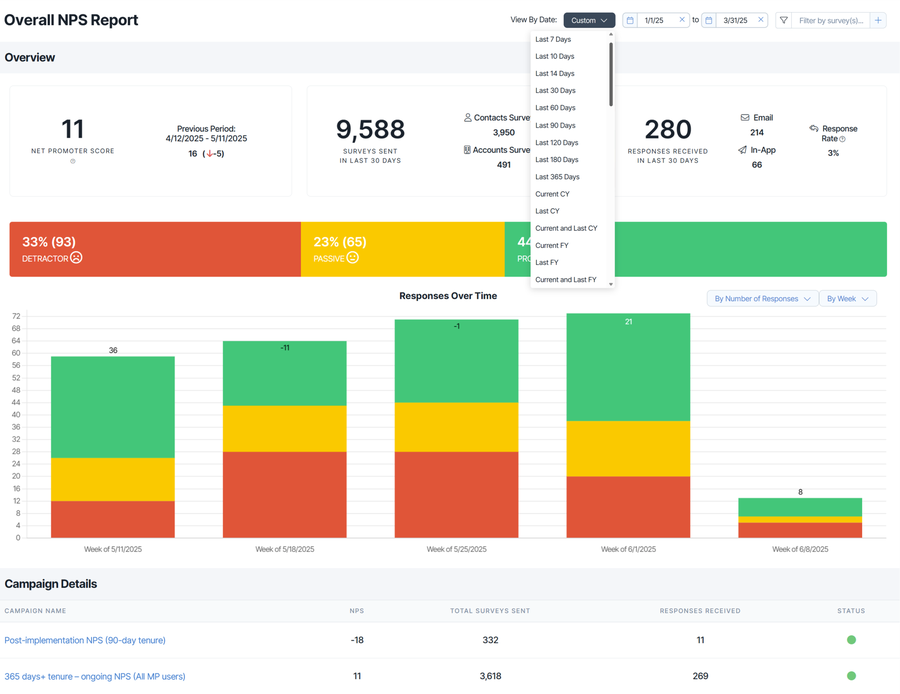
ChurnZero publishes no US dollar price. It has no current public pricing page, and a June 2026 press release names Professional and Enterprise editions without amounts, so treat the cost as quote only. Past survey history from other tools can be imported into NPS, CSAT and CES campaigns, and reports show sent, responses, engagement and the promoter, passive and detractor split by date, segment or campaign. The G2 rating covers the whole platform rather than NPS alone. Reviewers praise ease of use and automation and complain that setup is complex and takes time. Our ChurnZero and Gainsight comparison covers the platform side.
- Starting price
- Custom quote, no public price
- Channels
- Email and in-app announcement
- Triggers
- Recurring schedule or segment entry
- Account roll-up
- Account NPS metric on account profiles
- Custom surveys
- Enterprise Edition only
Closed-loop CX platforms
Closed-loop CX platforms put the follow-up first: a low score creates a case, an alert or a ticket for a named person.
AskNicely
Detractor answers become assigned, time-limited cases.
Fits a team that wants every detractor answer to open a case with an owner and a deadline, and has the budget for a sales-led platform.
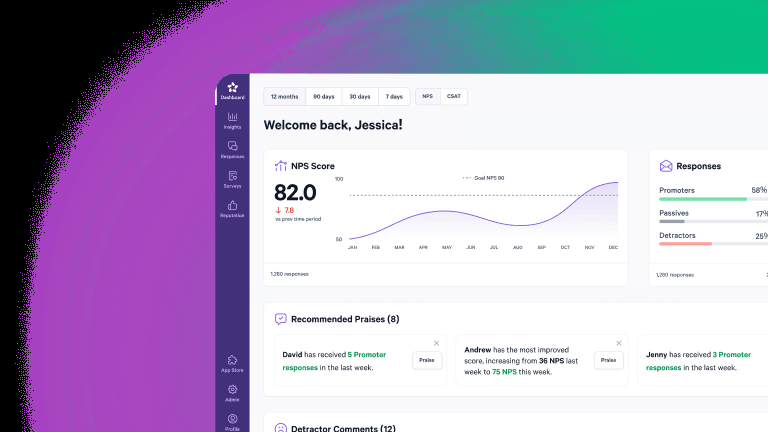
AskNicely surveys by email, SMS, web and kiosk. A Global Contact Rule sets how many days must pass before the same contact is surveyed again, plus a delay for new contacts, and a contact who unsubscribes is permanently marked Do Not Contact. Its case workflow can open a case automatically when a score is 6 or less, assign it to a user, track the SLA and send overdue notices, with email and mobile push alerts for the assignee. Advanced Case Management is on the Grow and Transform plans, while Learn has basic case management. Listed links include Salesforce, HubSpot, Microsoft Dynamics, Zendesk, Slack, Teams and the customer success platforms ChurnZero, ClientSuccess and Intercom. It breaks on account scoring: feedback is stored on contacts, and we found no documented account-level roll-up.
- You want detractor scores to open assigned cases with SLAs and alerts in Slack, Teams or a helpdesk.
- You need CRM and CS platform links such as Salesforce, HubSpot, ChurnZero or Intercom.
- You need a self-serve free trial or public prices before talking to sales.
- You need documented account-level NPS roll-ups; the vendor does not publish how contacts roll up to accounts.
- Users like
- Ease of use and customer support
- Users dislike
- Survey limitations, difficult reporting and limited customization
- Source: G2, 1,051 reviews
Plans, cadence and add-ons
AskNicely doesn't publish a price. The Learn, Grow and Transform plans start at 500 responses, all with unlimited users, and the price scales with response volume. Contracts are mainly annual, overages are billed and there is no free trial. Slack and Teams integration starts on Grow, and the vendor lists an SSO add-on at $1,500 a year. The vendor's own guidance is quarterly relationship NPS for most service and subscription businesses, event-triggered transactional NPS, and no sends near renewal or pricing talks in B2B. On G2 reviewers praise ease of use and support and complain about survey limitations, hard-to-use reporting and limited customization.
- Starting price
- Not published. Quote based from 500 responses per year, annual contract, no free trial.
- Pricing
- Not published, from 500 responses per year
- Free trial
- No
- Contact rule
- Resend delay in days, set on the Send page
- Case management
- Advanced on Grow and Transform; basic on Learn
Zonka Feedback
Many channels, a response inbox and case management.
Fits a team that surveys through many channels, including WhatsApp and SMS, and wants a response inbox for follow-up.
Zonka Feedback runs NPS, CSAT and CES across email, SMS, WhatsApp, website, in-product, an in-app SDK and offline devices. Scheduled NPS digests can go out daily, weekly or monthly, and a survey setting limits how often one respondent can be asked. Its G2 listing describes real-time alerts by email, SMS, WhatsApp, Slack and Microsoft Teams, a response inbox, case management with assignments, and workflow automation, with integrations for Salesforce, HubSpot, Intercom and Zendesk. The vendor's own pages list closing the feedback loop as a feature but don't map features to plans. It breaks on clarity: the pricing page shows no plan names or prices, and we found no account-level NPS roll-up in the published vendor pages.
- You want NPS across email, SMS, WhatsApp and in-app with alerts into Slack or Teams
- You want a response inbox and case management for follow-up on detractors
- You need per-account NPS scores rolled up by company, which is not documented
- You need public list prices or a free plan, since only a 14-day trial and a custom quote are published
- Users like
- Responsive support and easy onboarding
- Users dislike
- Learning curve on advanced automation and reporting
- Source: G2, 85 reviews

Price, trial and channels
Pricing is custom by response volume. G2 lists the Customer Feedback product from $99 a month and AI Feedback Intelligence from $399 a month, figures provided by Zonka. A 14-day free trial exists and no free plan is listed. Integrations beyond the CRMs include Pipedrive, Freshdesk, Help Scout, Front, Jira, Zapier and Make. A Zonka blog post describes routing by account owner and escalating by account value, but it reads as general practice rather than a documented feature, so we didn't count it. On G2 reviewers praise support and onboarding and complain about a learning curve on advanced automation and reporting, and about price for small teams.
- Starting price
- Custom quote; G2 lists from $99 per month for Customer Feedback
- Pricing
- Custom quote, no list prices on vendor page
- Trial
- 14 days, no free plan
- Account roll-up
- Not published
- Integrations
- Salesforce, HubSpot, Zendesk, Intercom, Slack, Teams
In-product and survey-suite NPS
In-product and survey-suite NPS tools are lighter than the platforms above: they ask the question where the customer already is and send the answer to Slack or the CRM.
Refiner
NPS inside the product, triggered by what the user did.
Fits a product-led team that wants the 0 to 10 question to appear inside the app after a specific action.
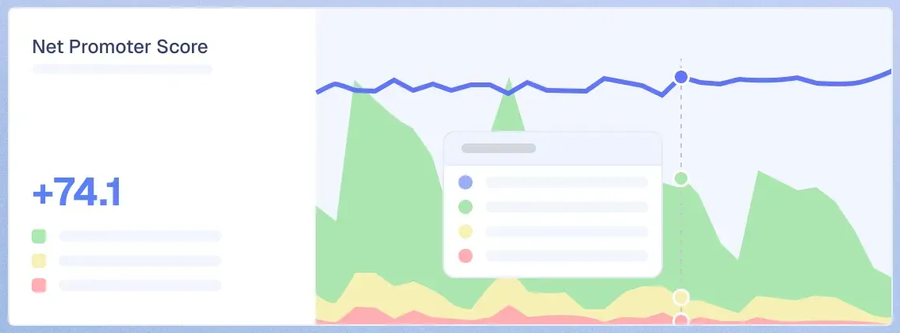
Refiner shows NPS inside web and mobile products through SDKs, as website pop-ups, by email and on hosted pages. A survey can launch on a page visit, a screen visit, a tracked event performed a set number of times, a time delay or a manual call. Recurring surveys can repeat on every trigger, once per session or on a sequence such as every 30 days from each user's last display. Throttling at survey and environment level uses a gap time as the main re-survey control. Slack, Teams and email notifications fire on a new response, a segment match or a tag, and are on the Essentials plan. It breaks on accounts: Refiner supports account traits when you pass an account object, but the NPS docs segment by user attributes and describe no account-level score.
- You want NPS shown inside your product, triggered by events and user traits.
- You want published USD pricing and a trial, with unlimited responses on paid plans.
- You need documented account-level NPS scores for B2B health scoring.
- You need an email-first relationship NPS program with case management and SLAs.
- Users like
- Ease of use and quick setup
- Users dislike
- Survey limitations and limited customization
- Source: G2, 26 reviews
Triggers, price and limits
Essentials is $149 a month and Growth is $279 a month at the 5,000 monthly active user tier, with annual billing saving 17 percent and Enterprise on quote. Paid plans include unlimited responses and unlimited team members. CRM, CDP and product analytics integrations, the REST API and webhooks start on Growth. The Salesforce docs show a contact-level example only. The pricing page lists a 30 day trial capped at 100 responses and a free plan of 25 responses a month afterward. G2 shows Essentials from $79 a month, which doesn't match the vendor page. On G2 reviewers praise ease of use and quick setup, and a few mention survey limitations and limited customization.
- Starting price
- Essentials $149 per month and Growth $279 per month at 5,000 MAU; Enterprise custom. 30 day trial.
- Pricing
- $149/mo Essentials, $279/mo Growth at 5,000 MAU
- Free trial
- 30 days, 100 responses
- Re-survey control
- Per-user gap time and recurring sequences
- CRM integrations
- Growth plan and up
Survicate
NPS across channels with HubSpot and Slack links.
Fits a team on HubSpot or Intercom that wants NPS across email, web and in-product with a published price.
Survicate runs NPS, CSAT and CES across email, web and in-app, and recurring NPS can monitor promoters and detractors over time. Website and in-product surveys target one of three audiences: anonymous visitors, identified users through a unique user ID, or a manual CSV list of up to 10,000 rows. Slack posts each response to a channel in real time, with conditions on answers or attributes, and email alerts can fire on survey completion or on custom answer conditions after a 5-minute delay. The HubSpot integration maps answers to contact properties and writes survey activity to the contact timeline. The Salesforce integration maps answers to Lead, Contact, Company, Opportunity and Case fields. It breaks on accounts and cases: the docs describe attributes per respondent with no separate account scope, and follow-up tasks live in your CRM or help desk.
- you want NPS, CSAT and CES surveys running inside your product and email this week, with a published price
- you run HubSpot and want survey answers written to contact properties and the timeline
- you need an account-level score across several contacts: Survicate's docs describe attributes per respondent and no account scope
- you want case management for follow-ups: it alerts and syncs, but tasks live in your CRM or help desk
- Users like
- an intuitive tool that needs little training and a fast, helpful contact
- Users dislike
- going live can depend on a developer when the survey must be added to a web interface (one reviewer)
- Source: G2, 215 reviews
Audiences, plans and gating
Growth is $114 a month billed annually with 250 responses a month on the pricing card, Pro is $349 and Enterprise is $569. The page doesn't say whether the Pro and Enterprise prices assume annual billing. Attribute targeting starts at Pro, event and behavior targeting plus survey sampling are Enterprise only, and AI categorization and sentiment analysis start at Pro. A 10-day free trial is offered. On G2 reviewers like an intuitive tool that needs little training and a fast, helpful contact at Survicate, and one reviewer says going live depends on a developer, because adding the survey to a web interface means changing code.
- Starting price
- Growth from $114 per month billed annually (250 responses a month), Pro from $349, Enterprise from $569; 10-day free trial
- Metrics
- NPS, CSAT, CES
- Channels
- Email, website, in-product, mobile, link
- Growth plan
- 250 responses a month on the pricing card
SurveySparrow
A free start with throttling and threshold alerts.
Fits a small team that wants a free start and a general survey tool that can also run relational and transactional NPS.
SurveySparrow runs relational, transactional and lifecycle NPS over email, SMS, WhatsApp, in-app, web and mobile. Throttling caps how many surveys a contact receives in a set number of days, either account-wide or per survey; a survey-level setting overrides the account-level one, and it applies to invitations rather than reminders. Alerts can be set on a threshold or on a percent change in a metric such as NPS and go to email or to Slack and Teams channels. Tickets can be created automatically from responses and routed by rules. Workflows and webhooks start at the Business plan. It breaks on B2B depth: its own comparison article positions it for B2C and small business and credits account-based features to CustomerGauge, and we found no account-level roll-up.
- You want a free plan or low-cost start with NPS over email, SMS, WhatsApp and in-app
- You want throttling and Slack or Teams alerts on NPS changes
- You need per-account NPS scores rolled up by company, which is not documented
- You need workflows and webhooks on a low tier, since they start at Business
Plans, limits and integrations
The plans are Free, Basic, Starter, Business and Enterprise. The pricing page shows no plan prices, so the figures here are G2's listed prices: Basic $19, Starter $39 and Business $79, with extra users $49 a month. Response limits are 2,500 on Basic, 15,000 on Starter and 36,000 on Business, and Business allows 3 users. Slack comes with Basic, HubSpot with Starter and Zendesk with Business. A 14-day trial needs no card and caps responses at 50 before reverting to the Free plan. The G2 rating of 4.4 across 2,065 reviews covers all survey use, not just NPS.
- Starting price
- Free plan; paid plans Basic, Starter, Business, Enterprise (G2 lists $19, $39, $79, billing period not shown)
- Free plan
- Yes, 1 user, response cap
- Trial
- 14 days, Business features, 50 responses
- Workflows
- Business plan and above
- Account roll-up
- Not published
How each tool scores accounts, throttles surveys and routes detractors
Three questions separate these tools for a customer success team: does the score belong to an account, how does the tool stop you from over-surveying one person, and where does a 0 to 6 answer go. Where a vendor doesn't say, the table says so.
| Tool | Account-level score | Re-survey control | Where a detractor answer goes |
|---|---|---|---|
| CustomerGauge | Yes, through an account hierarchy of stakeholders | Not described; vendor advises quarterly | Assigned to the account's CSM with a deadline, per the vendor |
| Retently | Exportable account-level scores on B2B Pro | Throttle of 1 to 365 days, 30 by default | Email, Slack or Teams alert and an autoreply; no case or task assignment found in the published vendor pages |
| ChurnZero | Account NPS metric on the account profile | No throttle setting documented; recurring schedule, reminders and drip scheduling | Segments, alerts and plays inside the platform |
| AskNicely | Not documented; feedback is stored on contacts | Global Contact Rule in days | Case with owner and SLA on Grow and Transform |
| Zonka Feedback | Not documented | Respondent throttling setting | Alerts, response inbox and case management; plan mapping not published |
| Refiner | Account traits supported; roll-up not documented | Gap time and per-user caps | Slack, Teams or email notification; score filter not confirmed |
| Survicate | Not found in the published vendor pages | Not found in the published vendor pages | Slack and email alerts; tasks live in your CRM |
| SurveySparrow | Not documented | Throttling per account or per survey | Threshold alerts and routed tickets; workflows from Business |
What NPS software costs
Refiner, Retently and Survicate publish a price you can read, and SurveySparrow lists a Free plan with paid tiers shown only on G2. CustomerGauge states a $24K starting price, and AskNicely, Zonka Feedback and ChurnZero are quote based. Free options are thin, not generous: SurveySparrow has a Free plan, Refiner drops to a small free plan after its trial, and the rest offer a trial at most.
| Tool | Entry price | Free plan or trial | What drives the cost |
|---|---|---|---|
| CustomerGauge | From $24K, period not stated | No trial; paid 60 to 90 day pilot | Account base size and modules |
| Retently | $100 a month (B2B Basic), $299 (B2B Pro) | 7-day trial, no free plan | Surveys, campaigns and seats |
| ChurnZero | Quote only | None found | Not published; custom surveys need the Enterprise edition |
| AskNicely | Quote only | No trial | Response volume, annual contract |
| Zonka Feedback | Quote only (G2 lists from $99 a month) | 14-day trial | Response volume |
| Refiner | $149 a month Essentials, $279 Growth at 5,000 monthly users | 30 day trial; small free plan | Monthly active users |
| Survicate | $114 a month Growth, billed annually | 10-day trial | Responses per month |
| SurveySparrow | Free; G2 lists $19, $39 and $79 for paid tiers, period not shown | Free plan; 14-day trial | Responses and users |
Retently's two B2B plans show how much a tier can change. The middle plan is where the account scores and most integrations arrive.
Retently- B2B Basic · $100 a month3,000 surveys, 3 campaigns, 3 seats, email and link surveys, no CRM and no API
- B2B Pro · $299 a month10,000 surveys, 10 seats, API and integrations except Salesforce, embed, pop-up and feedback button surveys, benchmarking and account-level exportable scores
- Enterprise · quoteSalesforce and enterprise features
How often to survey an account
Two vendors give a cadence, and their advice on renewal timing differs. AskNicely recommends quarterly relationship NPS for most service and subscription businesses, event-triggered NPS after a specific interaction, and no survey near renewal or pricing talks in B2B. CustomerGauge suggests relationship surveys every quarter, at least twice a year, ideally about three months before renewal, and transactional surveys within 24 hours of a service interaction. New regular email and in-app campaigns in Retently default to a 30 day throttle, and link campaigns have none.
- Count surveys per person, not per account. An account with six contacts can receive six surveys in a week unless the tool throttles across campaigns.
- Keep a transactional survey after a support ticket separate from the relationship survey, and let the throttle see both.
- Report the account score from several contacts when you can, and mark accounts where only one person answered.
- Do not send a relationship survey in the middle of a renewal or pricing conversation.
NPS program checklist
A score isn't the goal; the follow-up is. Check these items before you send the first survey, not after the first detractor replies.
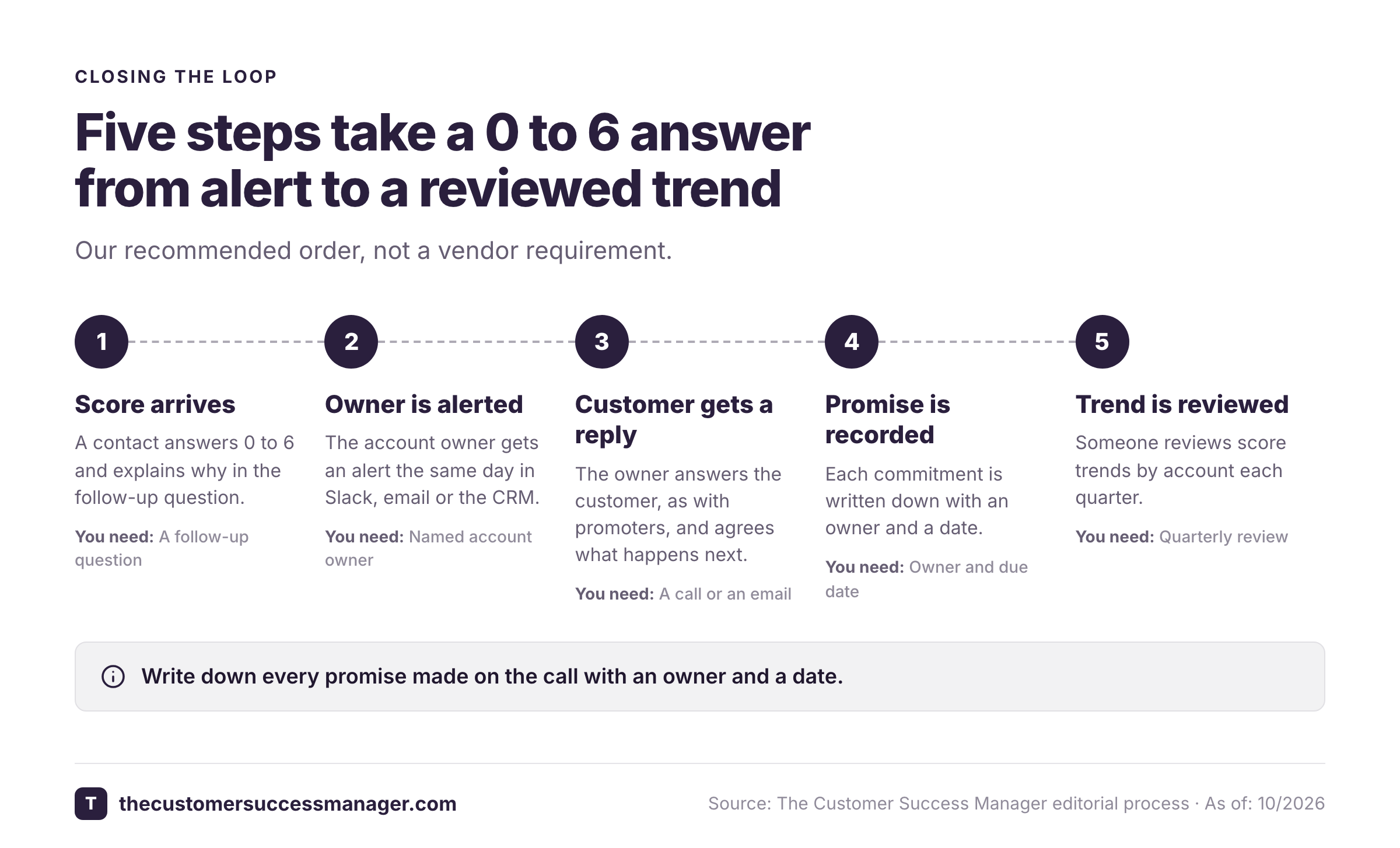
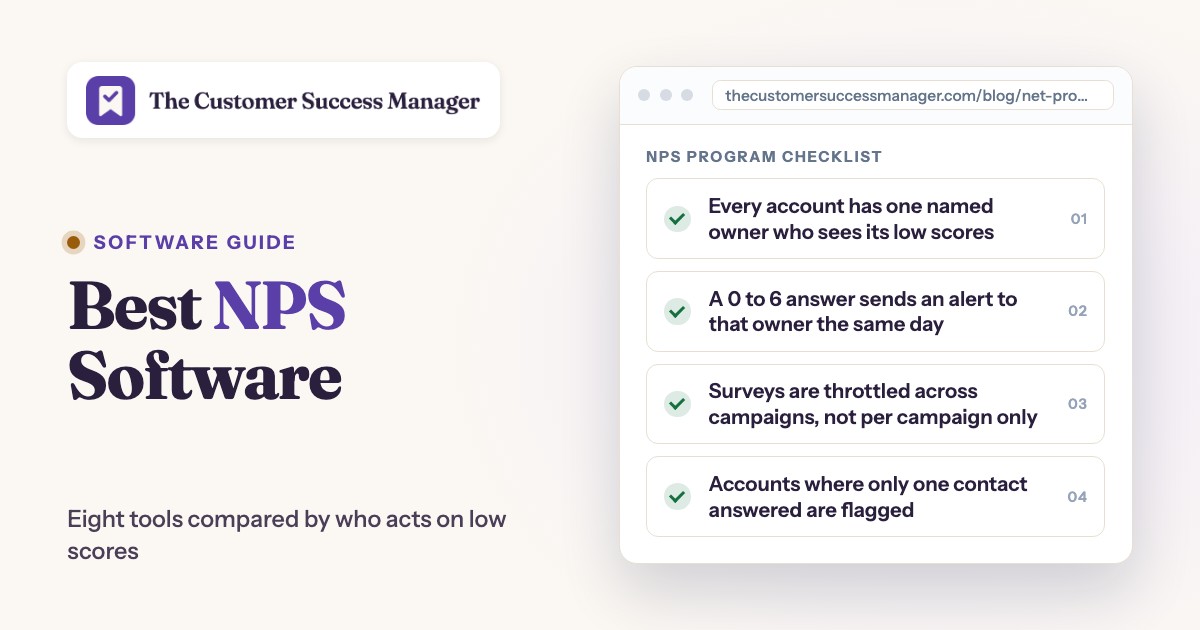
- Every account has one named owner who sees its low scores
- A 0 to 6 answer sends an alert to that owner the same day
- The follow-up question asks for the reason behind the score
- Surveys are throttled across campaigns, not per campaign only
- The CRM or CS platform shows the last score on the account
- A reply to the customer is sent for promoters and detractors alike
- Accounts where only one contact answered are flagged
- Survey timing avoids renewal and pricing conversations
- Promises made on a detractor call are written down with an owner and a date
- Someone reviews score trends by account each quarter
How to choose NPS software
Start with who acts on a low score, then test three things: whether the tool scores the account, how it limits repeat surveys and which plan unlocks the alerts and CRM links you need.
- Account-level NPS next to revenue and renewal dateCustomerGauge
- A published B2B price with a trialRetently
- Survey scores that feed health scores and playsChurnZero
- Detractor cases with owners and SLAsAskNicely (Grow or Transform)
- Many channels including WhatsApp, with a response inboxZonka Feedback
- NPS inside the product after an eventRefiner
- NPS plus HubSpot contact propertiesSurvicate
- A free startSurveySparrow
Do I need NPS software or a survey tool I already have?
If you send one survey a quarter to a few dozen accounts, a form tool and a spreadsheet can calculate the score. NPS software earns its cost when you need scheduling across many people, throttling, alerts to named owners and a record on the account. Our guide to the best customer experience management software covers the heavier platforms, and the best customer retention software guide covers tools that act on churn signals.
Is NPS enough on its own?
NPS alone isn't enough. A promoter can still leave and a detractor can still renew, and one number hides which contact or which feature caused the answer. Pair the score with usage and support data from your customer success platform or the customer engagement software you use, and read the comments before the chart.
What NPS doesn't record: promises made on the detractor call
An NPS tool keeps the score, the comment and perhaps a case. What NPS doesn't record is what your team told the customer when someone called back: "we will fix the export bug by the 15th" or "your CSM will join the next planning call." Those commitments live in call notes and email threads, and they're easy to lose when the account changes hands.
FAQ
How do you calculate a net promoter score?
Ask people how likely they are to recommend you on a scale of 0 to 10. The percentage who answer 9 or 10 are promoters and the percentage who answer 0 to 6 are detractors. Subtract the detractor percentage from the promoter percentage. The result runs from -100 to +100, and passives (7 to 8) only count in the total.
What is the best free NPS software?
SurveySparrow has a Free plan with one user and a small response allowance, and Refiner's pricing page lists a free plan of 25 responses a month after a 30 day trial. Neither includes account-level scoring. Retently, Survicate and Zonka Feedback offer trials rather than free plans.
How often should you send NPS surveys to B2B customers?
AskNicely suggests a quarterly relationship survey for most service and subscription businesses. CustomerGauge suggests every quarter and at least twice a year, with one about three months before renewal, and transactional surveys within 24 hours of an interaction. AskNicely advises avoiding sends near renewal or pricing talks. Use a throttle so one person isn't surveyed twice in a short window.
Can NPS software score a whole account instead of one contact?
NPS software can score a whole account in some cases. CustomerGauge rolls stakeholder feedback into an account-level score through an account hierarchy, ChurnZero updates an Account NPS metric from each response, and Retently lists account-level exportable scores on B2B Pro. For AskNicely, Zonka Feedback, Refiner, Survicate and SurveySparrow we found no documented account roll-up.
Do you need a licence to use the NPS name?
AskNicely and Refiner print notices naming Bain and Company, Satmetrix Systems and Fred Reichheld as owners of the NPS marks, and Retently's notice names Bain and Company, NICE Systems and Fred Reichheld. We can't tell you whether your use needs a licence. Ask Bain or your lawyer if you plan to use the name in a product or in client work.
Related: best voice of customer software compares eight tools by who they hear, where the answer goes and which plan gates it.